2023 · GS Paper 4 · Q9 · 20 marks
At 9 pm on Saturday evening, Rashika, a Joint Secretary, was still engrossed in her work in her office. Her husband, Vikram, is an executive in an MNC and frequently out of town in connection with his work. Their two children aged 5 and 3 are looked after by their domestic helper. At 9:30 pm her superior, Mr. Suresh calls her and asks her to prepare a detailed note on an important matter to be discussed in a meeting in the Ministry. She realises that she will have to work on Sunday to finish the additional task given by her superior. She reflects on how she had looked forward to this posting and had worked long hours for months to achieve it. She had kept the welfare of people uppermost in discharging her duties. She feels that she has not done enough justice to her family and she has not fulfilled her duties in discharging essential social obligations. Even as recently as last month she had to leave her sick child in the nanny's care as she had to work in the office. Now, she feels that she must draw a line, beyond which her personal life should take precedence over her professional responsibilities. She thinks that there should be reasonable limits to the work ethics such as punctuality, hard work, dedication to duty and selfless service. (a) Discuss the ethical issues involved in this case. (b) Briefly describe at least four laws that have been enacted by the Government with respect to providing a healthy, safe and equitable working environment for women. (c) Imagine you are in a similar situation. What suggestions would you make to mitigate such working conditions?
In short
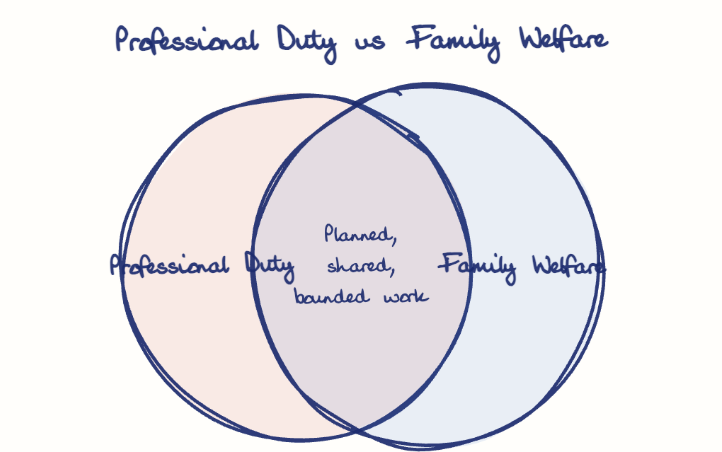
Rashika's case pits Professional Duty against Family Welfare, worsened by a gendered care burden and an unempathetic superior. Laws such as the POSH Act 2013, the Maternity Benefit Amendment 2017, the Code on Wages 2019 and the OSH Code 2020 protect women at work.
Model answer
Ghissu Editorial · Verified 4 Oct 2026 · 286 words
Work-life imbalance
Constant weekend work turns dedication into excess, and burnout harms judgement.
Gendered care burden
Women spend 289 minutes a day on unpaid domestic work against 88 for men (Time Use Survey 2024).
Leadership without empathy
Mr. Suresh's late demand shows poor planning and low Emotional Intelligence.
POSH Act, 2013
Following Vishaka (1997) [case], Internal Committees in offices with ten or more staff.
Maternity Benefit (Amendment) Act, 2017
26 weeks' paid leave and creches for 50 or more employees.
Code on Wages, 2019
Equal pay for the same or similar work, carrying forward the 1976 Act.
OSH Code, 2020
Night shifts only with consent and safe transport.
Child Care Leave
Up to 730 days for women central government employees.
Dialogue and planning
Finish the urgent note, then agree with Mr. Suresh on earlier briefs, and share drafting through the team and e-Office.
Shared care
Agree equal parenting with Vikram and use Child Care Leave when needed.
Institutional reform
Seek an office creche, flexible hours and Mission Karmayogi iGOT [scheme] training in humane team management.
This model answer is indicative and the model can make mistakes; please verify key facts independently.
Practise this question
1Get the answer sheet
Sized for this question.
2Write your answer
Timed, by hand.
3Get it marked
Your score and what to fix.
This chapter in the exam
Personal, Family and Social-Norm Dilemmas6 questions
Asked in 4 of 14 sittings since 2013
- 2017You are aspiring to become an IAS officer and you have cleared various stages and now you have been selected for the personal interview. On the day of the interview, on the way to the venue you saw an accident where a mother and child who happen to be your relatives were badly injured. They needed immediate help. What would you have done in such a situation ? Justify your action.
- 2017You are the manager of a spare parts company A and you have to negotiate a deal with the manager of a large manufacturing company B. The deal is highly competitive and sealing the deal is critical for your company. The deal is being worked out over a dinner. After dinner the manager of manufacturing company B offered to drop you to the hotel in his car. On the way to the hotel he happens to hit a motorcycle injuring the motorcyclist badly. You know the manager was driving fast and thus lost control. The law enforcement officer comes to investigate the issue and you are the sole eyewitness to it. Knowing the strict laws pertaining to road accidents you are aware that your honest account of the incident would lead to the prosecution of the manager and as a consequence the deal is likely to be jeopardized, which is of immense importance to your company. What are the dilemmas you face ? What will be your response to the situation ?
All 6 questions, sorted by sub-topic, with model answers and practice.
Question from the official UPSC Civil Services (Main) Examination 2023 paper. Answer written by Ghissu's engine and checked against our editorial standards. Found an error? Tell us and we correct it within 48 hours.