2024 · GS Paper 1 · Q20 · 15 marks
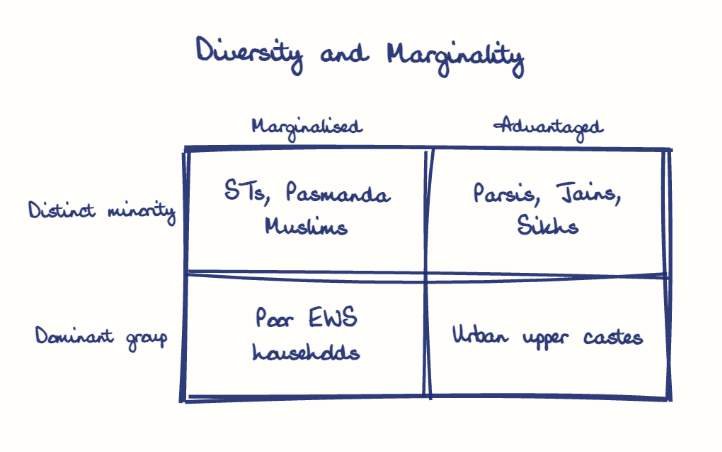
Critically analyse the proposition that there is a high correlation between India's cultural diversities and socio-economic marginalities.
In short
India's cultural diversities correlate with socio-economic marginality largely for SCs, STs and sections of Muslims, but not as a general rule, since hierarchy and uneven development drive deprivation. The Global MPI 2021 found five of six poor Indians among STs, SCs and backward castes, yet Jains had 94.9% literacy.
Model answer
Ghissu Editorial · Verified 4 Oct 2026 · 276 words
Caste hierarchy
Dumont's *Homo Hierarchicus* explains why ritual ranking by purity survives today as SC landlessness, occupational segregation and manual scavenging.
Tribes and religious minorities
The Xaxa Committee (2014) recorded tribal displacement in the mineral belt, while the Sachar Committee (2006) found Muslims, 13.4% of Indians, holding under 5% of government jobs.
Regional otherness
The Bezbaruah Committee (2014) documented discrimination against North-Eastern people in Indian cities, where cultural difference blocks housing and work.
Prosperous minorities
Jains had 94.9% literacy in Census 2011, and Parsis and Sikhs prosper in business, so distinctiveness is not destiny.
Inequality within groups
The Rohini Commission found a quarter of OBC sub-castes taking 97% of central benefits, and *Davinder Singh* (2024) allowed SC sub-classification.
Geography and class
Tribal-majority Mizoram had 91.3% literacy (Census 2011), and the EWS quota (2019) recognises poverty among dominant groups.
Targeted measures
Use sub-group Census data, combine Aspirational Districts with PM-JANMAN for PVTGs, and enact a comprehensive anti-discrimination law.
This model answer is indicative and the model can make mistakes; please verify key facts independently.
Practise this question
1Get the answer sheet
Sized for this question.
2Write your answer
Timed, by hand.
3Get it marked
Your score and what to fix.
This chapter in the exam
Salient features of Indian Society, Diversity of India23 questions
Asked in 13 of 14 sittings since 2013
- 2026Unity in diversity remains the defining feature of Indian society despite the challenges from communalism and regionalism. Comment.
- 2026Is caste disappearing in urban India? Illustrate your answer with examples.
All 23 questions, sorted by sub-topic, with model answers and practice.
Question from the official UPSC Civil Services (Main) Examination 2024 paper. Answer written by Ghissu's engine and checked against our editorial standards. Found an error? Tell us and we correct it within 48 hours.