2024 · GS Paper 1 · Q9 · 10 marks
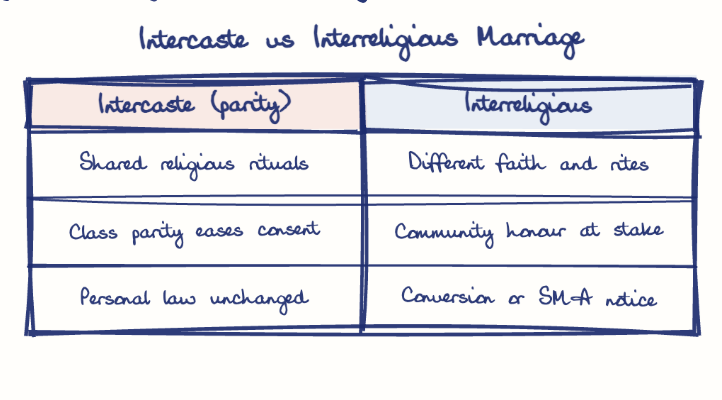
Intercaste marriages between castes which have socio-economic parity have increased, to some extent, but this is less true of interreligious marriages. Discuss.
In short
Intercaste marriages have grown among castes of similar class because urbanisation, education and legal protection ease family consent, while religion remains a fortified boundary of community, law and politics. Pew Research's 2021 survey found 99% of married Hindus and 98% of married Muslims wedded within their faith.
Model answer
Ghissu Editorial · Verified 4 Oct 2026 · 292 words
Urbanisation and education
Co-education, city jobs and anonymity loosen kin control, bringing together partners of similar class.
Class over caste
When income, education and lifestyle match, families fear less "loss of status", so marriage increasingly follows status homogamy rather than strict jati endogamy.
Law and incentives
The Special Marriage Act, 1954, *Lata Singh* (2006) and *Shakti Vahini* (2018) protect choice, and the Dr. Ambedkar Scheme (2013) rewards marriages with a Dalit spouse.
Only to some extent
Unions crossing the Dalit line still meet violence, as in the Udumalpet (2016) and Miryalaguda (2018) honour killings.
Community boundary
Pew (2021) found about two-thirds of Hindus and four-fifths of Muslims wanting to stop women marrying outside the faith.
Legal friction
Conversion or the Special Marriage Act's 30-day notice invites harassment, though *Safiya Sultana* (2021) made publication optional.
Politics and segregation
Anti-conversion laws such as Uttar Pradesh's (2021), "love jihad" narratives and ghettoisation deter couples despite *Shafin Jahan* (2018).
This model answer is indicative and the model can make mistakes; please verify key facts independently.
Practise this question
1Get the answer sheet
Sized for this question.
2Write your answer
Timed, by hand.
3Get it marked
Your score and what to fix.
This chapter in the exam
Salient features of Indian Society, Diversity of India23 questions
Asked in 13 of 14 sittings since 2013
- 2026Unity in diversity remains the defining feature of Indian society despite the challenges from communalism and regionalism. Comment.
- 2026Is caste disappearing in urban India? Illustrate your answer with examples.
All 23 questions, sorted by sub-topic, with model answers and practice.
Question from the official UPSC Civil Services (Main) Examination 2024 paper. Answer written by Ghissu's engine and checked against our editorial standards. Found an error? Tell us and we correct it within 48 hours.