2024 · GS Paper 2 · Q10 · 10 marks
Critically analyse India's evolving diplomatic, economic and strategic relations with the Central Asian Republics (CARs) highlighting their increasing significance in regional and global geopolitics.
In short
India's ties with the Central Asian Republics have deepened diplomatically and strategically through SCO membership, summits and exercises, but economic links stay thin because geography and sanctions block access. The first India-Central Asia Summit in January 2022 gave the partnership a summit-level format.
Model answer
Ghissu Editorial · Verified 4 Oct 2026 · 276 words
Diplomatic
The 2015 visit to all five republics, the India-Central Asia Dialogue since 2019 and SCO membership (2017), with India's chair in 2023, give India regular political access to the region.
Economic
A US$ 1 billion credit line (2020), grant projects and Kazakh uranium for Indian reactors build ties, though trade remains a small fraction of China's.
Strategic
Exercises such as KAZIND, Dustlik and Khanjar, and counter-terror work through the SCO's Regional Anti-Terrorist Structure underpin cooperation rooted in a shared stake in a stable Afghanistan.
Connectivity Deficit
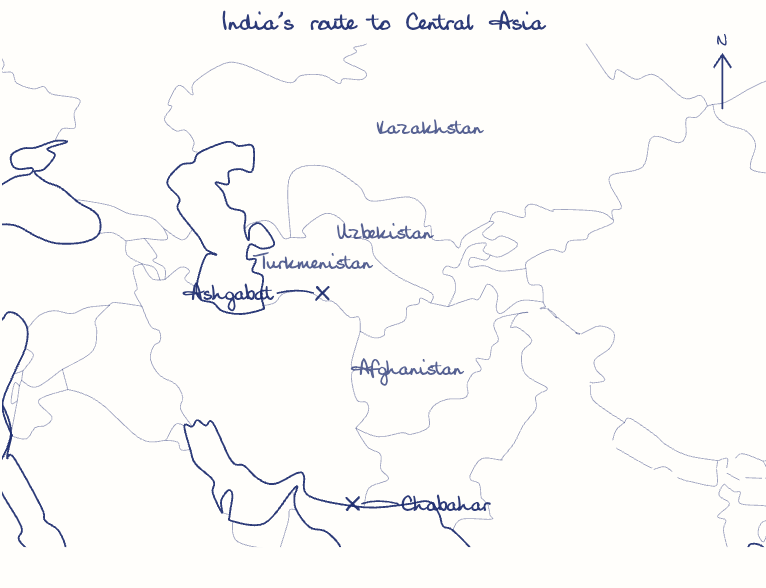
With Pakistan denying transit and Afghanistan unstable, India relies on this route, exposed to US sanctions on Iran, while TAPI stays stalled.
Great-Power Competition
China's Belt and Road and Xi'an summit (2023), Russia's security primacy and C5+1 formats show the region's value and crowd India out.
Resources and Corridors
Kazakhstan leads world uranium output, and post-Ukraine routes such as the Middle Corridor raise the region's Eurasian weight.
This model answer is indicative and the model can make mistakes; please verify key facts independently.
Practise this question
1Get the answer sheet
Sized for this question.
2Write your answer
Timed, by hand.
3Get it marked
Your score and what to fix.
This chapter in the exam
Regional12 questions
Asked in 10 of 14 sittings since 2013
- 2026“IPMDA (Indo-Pacific Partnership for Maritime Domain Awareness) bridges the gap between India’s SAGAR (Security and Growth for All in the Region) vision and the Quad’s collective Indo-Pacific strategy.” Make a critical assessment of the statement focusing on IPMDA.
- 2025"Energy security constitutes the dominant kingpin of India's foreign policy, and is linked with India's overarching influence in Middle Eastern countries." How would you integrate energy security with India's foreign policy trajectories in the coming years?
All 12 questions, sorted by sub-topic, with model answers and practice.
Question from the official UPSC Civil Services (Main) Examination 2024 paper. Answer written by Ghissu's engine and checked against our editorial standards. Found an error? Tell us and we correct it within 48 hours.