2024 · GS Paper 3 · Q6 · 10 marks
What is the technology being employed for electronic toll collection on highways? What are its advantages and limitations? What are the proposed changes that will make this process seamless? Would this transition carry any potential hazards?
In short
Highway tolls are collected through RFID-based FASTag under NPCI's NETC programme, which cuts queues but charges by stretch and needs plazas, and GNSS-based and free-flow tolling are proposed to make it seamless. The shift carries privacy, signal, spoofing and exclusion hazards that need NavIC and DPDP Act safeguards.
Model answer
Ghissu Editorial · Verified 4 Oct 2026 · 288 words
The technology
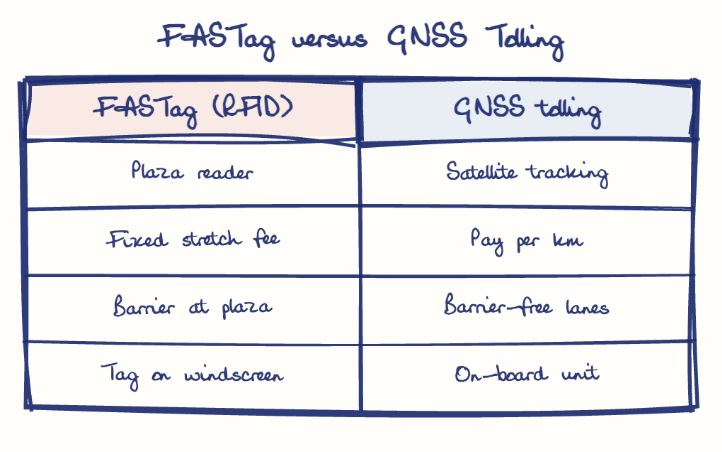
RFID under NPCI's National Electronic Toll Collection programme; a passive FASTag on the windscreen is read at plazas and the toll debited from a linked account, mandatory since February 2021.
Advantages
Shorter queues, less fuel waste and emissions, no cash leakage, transparent revenue data for NHAI, and products like the FASTag Annual Pass (August 2025).
Limitations
Read failures from damaged tags, payment for the full stretch rather than distance travelled, and tag misuse that prompted "One Vehicle, One FASTag" (2024).
GNSS tolling
Fee Rules amended in 2024 allow distance-based tolling through an on-board unit, piloted on the Bengaluru-Mysuru (NH-275) and Panipat-Hisar (NH-709) stretches.
Multi-Lane Free Flow
Number-plate cameras and FASTag readers on gantries let vehicles pass without stopping.
Privacy hazard
Continuous location tracking risks surveillance and needs safeguards under the DPDP Act, 2023.
Technical and social hazards
Signal loss in tunnels, spoofing, reliance on foreign satellites unless NavIC is used, wrong billing on parallel roads, and digital exclusion.
This model answer is indicative and the model can make mistakes; please verify key facts independently.
Practise this question
1Get the answer sheet
Sized for this question.
2Write your answer
Timed, by hand.
3Get it marked
Your score and what to fix.
This chapter in the exam
IT5 questions
Asked in 5 of 14 sittings since 2013
- 2026What is agentic Artificial Intelligence (AI)? Explain its working. Describe its applications with suitable examples. Discuss the advantages, risks and challenges associated with agentic AI systems. (Answer in 250 words)
- 2023Introduce the concept of Artificial Intelligence (AI). How does AI help clinical diagnosis? Do you perceive any threat to privacy of the individual in the use of AI in healthcare?
All 5 questions, sorted by sub-topic, with model answers and practice.
Question from the official UPSC Civil Services (Main) Examination 2024 paper. Answer written by Ghissu's engine and checked against our editorial standards. Found an error? Tell us and we correct it within 48 hours.