2025 · GS Paper 2 · Q13 · 15 marks
Discuss the evolution of collegium system in India. Critically examine the advantages and disadvantages of the system of appointment of the Judges of the Supreme Court of India and that of the USA.
In short
The collegium evolved through the Judges Cases from executive to judicial primacy and survived the NJAC challenge in 2015; it protects independence but lacks transparency, while the US model is democratic but partisan. The Second Judges Case (1993) read consultation with the CJI as concurrence.
Model answer
Ghissu Editorial · Verified 4 Oct 2026 · 291 words
From executive to judicial primacy
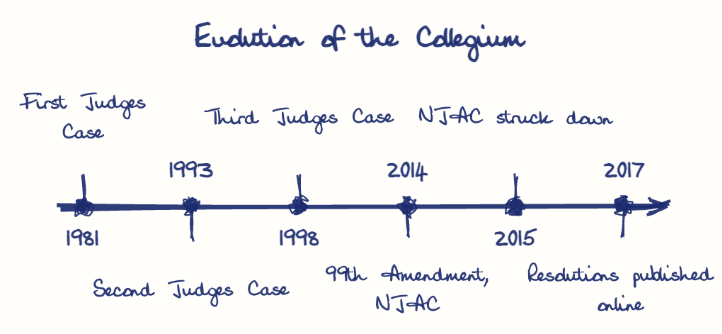
S.P. Gupta (1981) left the final word with the government, but the Second (1993) and Third (1998) Judges Cases created a collegium of the CJI and four senior-most judges.
NJAC episode
The 99th Amendment's NJAC (2014) was struck down 4:1 in 2015 as a breach of judicial independence, a part of the basic structure; since 2017 collegium resolutions are published online, though the Memorandum of Procedure is still unfinalised.
Collegium
It shields appointments from political favour, but it is opaque, open to the "uncle judge" charge of the Law Commission's 230th Report (2009), and had seated only 11 women judges by 2025.
US model
It is democratic and holds open Senate hearings, but it is partisan, as the blocked Merrick Garland nomination (2016) and rushed Amy Coney Barrett confirmation (2020) show.
Rule-bound reform
Finalise the Memorandum of Procedure with written criteria for merit and diversity, a secretariat to vet candidates, and time limits for government action on recommendations.
This model answer is indicative and the model can make mistakes; please verify key facts independently.
Practise this question
1Get the answer sheet
Sized for this question.
2Write your answer
Timed, by hand.
3Get it marked
Your score and what to fix.
This chapter in the exam
Comparison of the Indian Constitutional Scheme with That of Other Countries8 questions
Asked in 7 of 14 sittings since 2013
- 2026Examine how the separation of powers is practised in India compared to the rigid presidential model of the United States of America. In this context, compare the actual authority of the Indian Prime Minister with that of the President of the USA.
- 2025Compare and contrast the President's power to pardon in India and in the USA. Are there any limits to it in both the countries? What are preemptive pardons?
All 8 questions, sorted by sub-topic, with model answers and practice.
Question from the official UPSC Civil Services (Main) Examination 2025 paper. Answer written by Ghissu's engine and checked against our editorial standards. Found an error? Tell us and we correct it within 48 hours.