2025 · GS Paper 2 · Q10 · 10 marks
"With the waning of globalization, post-Cold War world is becoming a site of sovereign nationalism." Elucidate.
In short
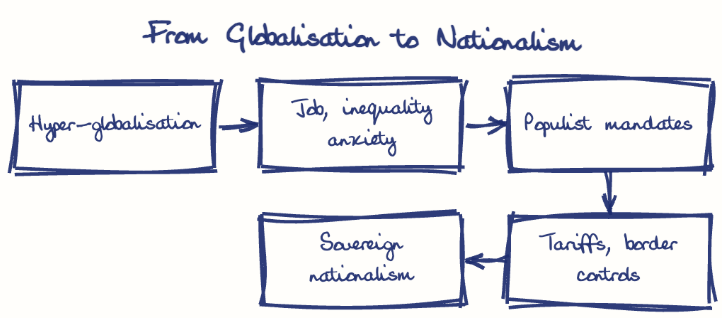
Since the 2008 crisis and the pandemic, the post-Cold War drive to hyper-globalisation has given way to states reasserting control over trade, territory and technology, though globalisation is being rewired rather than reversed. The WTO Appellate Body has lacked a quorum since December 2019.
Model answer
Ghissu Editorial · Verified 4 Oct 2026 · 268 words
Defensive trade
The US-China tariff war from 2018 and the extra 25% US duty on Indian goods in August 2025, taking the total to 50%, mark a retreat from open markets.
Weaker rules
The WTO Appellate Body has lacked a quorum since December 2019, so trade disputes can be "appealed into the void".
Exits and hoarding
Brexit (2020) and export curbs on vaccines and medicines in 2020-21 put national control ahead of shared gains.
Territorial assertion
Russia's annexation of Crimea (2014) and invasion of Ukraine (2022), and Washington's push to acquire Greenland, revive hard claims of sovereignty.
Technological sovereignty
The US CHIPS Act (2022), EU strategic autonomy and India's Atmanirbhar Bharat (2020) prioritise national supply chains.
Narrower security goals
The US National Security Strategy of November 2025 shifts from global dominance to core national interests.
Not autarky
Selective deals, such as India's agreements with the UK (2025) and the EU, show globalisation being rewired, not reversed.
This model answer is indicative and the model can make mistakes; please verify key facts independently.
Practise this question
1Get the answer sheet
Sized for this question.
2Write your answer
Timed, by hand.
3Get it marked
Your score and what to fix.
This chapter in the exam
Global6 questions
Asked in 6 of 14 sittings since 2013
- 2026“BRICS acts as a powerful counterweight in global governance, actively amplifying the voice and influence of the Global South.” Explain the role of BRICS in projecting itself as an alternative to other groupings.
- 2022How will I2U2 (India, Israel, UAE and USA) grouping transform India's position in global politics ?
All 6 questions, sorted by sub-topic, with model answers and practice.
Question from the official UPSC Civil Services (Main) Examination 2025 paper. Answer written by Ghissu's engine and checked against our editorial standards. Found an error? Tell us and we correct it within 48 hours.