2025 · GS Paper 3 · Q16 · 15 marks
India aims to become a semiconductor manufacturing hub. What are the challenges faced by the semiconductor industry in India ? Mention the salient features of the India Semiconductor Mission.
In short
India's semiconductor push faces huge capital costs, concentrated technology, missing inputs like ultra-pure water and gases, and a shortage of skilled workers. The Rs 76,000 crore India Semiconductor Mission funds 50% of fab and assembly costs and had approved ten projects worth Rs 1.60 lakh crore by December 2025.
Model answer
Ghissu Editorial · Verified 4 Oct 2026 · 308 words
Capital and gestation
A fab costs billions and pays back slowly; Tata-PSMC's Dholera fab needs about Rs 91,000 crore, and the 2013 fab consortia collapsed for want of finance.
Technology access
Process know-how and tools rest with TSMC, Samsung and ASML, and US export controls make transfer geopolitical.
Ecosystem gaps
Fabs need uninterrupted power, ultra-pure water, gases and wafers that India still imports.
Talent and R&D
The sector needs one million more skilled workers by 2030 (PIB), while R&D spending is near 0.64% of GDP.
Institutional design
Launched in December 2021 with a Rs 76,000 crore outlay, ISM sits in the Digital India Corporation under MeitY.
Fiscal support
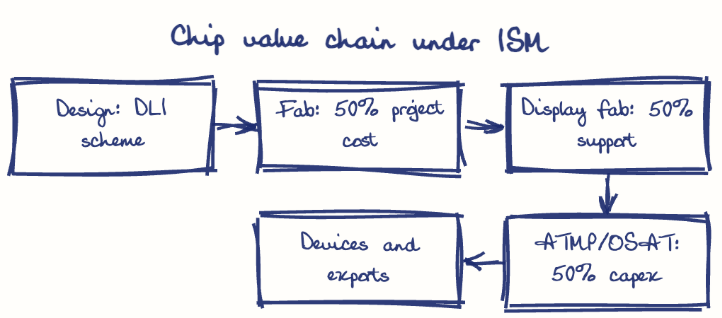
Fabs get 50% of project cost and ATMP/OSAT units 50% of capex, attracting Micron's Sanand plant (2023).
Design push
The Design Linked Incentive has sanctioned 23 chip-design projects and Chips to Startup trains 85,000 engineers.
Results
Ten projects worth Rs 1.60 lakh crore were approved across six states by December 2025, and ISM 2.0 follows.
Partners and demand
Deepen iCET and Quad technology ties and use public procurement to give new fabs an assured market.
This model answer is indicative and the model can make mistakes; please verify key facts independently.
Practise this question
1Get the answer sheet
Sized for this question.
2Write your answer
Timed, by hand.
3Get it marked
Your score and what to fix.
This chapter in the exam
Computers1 question
Asked in 1 of 14 sittings since 2013
Question from the official UPSC Civil Services (Main) Examination 2025 paper. Answer written by Ghissu's engine and checked against our editorial standards. Found an error? Tell us and we correct it within 48 hours.