2025 · GS Paper 3 · Q20 · 15 marks
Why is maritime security vital to protect India's sea trade? Discuss maritime and coastal security challenges and the way forward.
In short
Maritime security is vital because about 95% of India's trade by volume and 80% of its oil and gas move by sea through vulnerable choke points. Piracy, Houthi attacks, Chinese presence, sea-borne smuggling and fragmented coastal control demand a maritime security law and stronger domain awareness.
Model answer
Ghissu Editorial · Verified 4 Oct 2026 · 287 words
Choke points
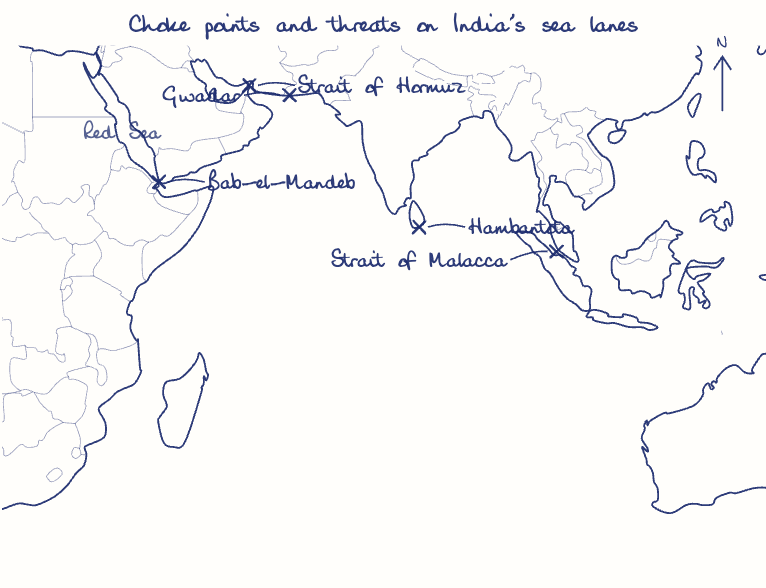
Trade passes through Hormuz, Bab-el-Mandeb and Malacca, so any blockade disrupts supply chains and raises prices.
Port-led growth
Major ports handled 855 million tonnes in 2024-25 (PIB, 2025), and Maritime Amrit Kaal Vision 2047 assumes safe sea lanes.
Costs and assets
Secure waters keep insurance low and protect Mumbai High, fisheries and undersea cables; INS Kolkata's rescue of MV Ruen (2024) shows the Navy's role.
Piracy and non-state attacks
Somali piracy and Houthi missiles threaten merchant shipping in the western Indian Ocean.
Strategic competition
Chinese survey vessels such as Yuan Wang 5 (2022) and ports at Gwadar and Kyaukpyu raise surveillance concerns.
Smuggling
Heroin seized at Mundra (2021) and methamphetamine near the Andamans (2024) show sea-borne organised crime.
Porous coast
The 26/11 landing and an 11,098 km coastline expose gaps in coordination among agencies.
Unified command
Enact a maritime security law that gives the National Maritime Security Coordinator clear authority over all agencies.
Domain awareness and partners
Extend coastal radars and boat transponders, share data through the IFC-IOR and run MAHASAGAR-based patrols with neighbours.
This model answer is indicative and the model can make mistakes; please verify key facts independently.
Practise this question
1Get the answer sheet
Sized for this question.
2Write your answer
Timed, by hand.
3Get it marked
Your score and what to fix.
This chapter in the exam
Border Areas12 questions
Asked in 9 of 14 sittings since 2013
- 2026Ladakh is strategically located between China and Pakistan. As a measure to win hearts and minds of locals, discuss the Border Area Development Programmes (BADP) by the Central Government and civic actions by the Army. Also discuss demand of promulgation of provision of the Sixth Schedule of constitution for Ladakh. (Answer in 150 words)
- 2024India has a long and troubled border with China and Pakistan fraught with contentious issues. Examine the conflicting issues and security challenges along the border. Also give out the development being undertaken in these areas under the Border Area Development Programme (BADP) and Border Infrastructure and Management (BIM) Scheme.
All 12 questions, sorted by sub-topic, with model answers and practice.
Question from the official UPSC Civil Services (Main) Examination 2025 paper. Answer written by Ghissu's engine and checked against our editorial standards. Found an error? Tell us and we correct it within 48 hours.