2025 · GS Paper 4 · Q12 · 20 marks
Ashok is Divisional Commissioner of one of the border districts of the North East State. A few years back, Military has taken over the neighbouring country after overthrowing the elected civil government. Civil war situation is prevailing in the country especially in last two years. However, internal situation further deteriorated due to rebel groups taking over control of certain populated areas near own border. Due to intense fight between military and rebel groups, civilian casualties has increased manifold in recent past. In the meantime, in one night Ashok got information from the local police guarding the border check post that there are about 200-250 people mainly women and children trying to cross over to our side of the border. There are also about 10 soldiers with their weapons in military uniform part of this group who wants to cross over. Women and Children are also crying and begging for help. A few of them are injured and bleeding profusely need immediate medical care. Ashok tried to contact Home Secretary of the State but failed to do so due to poor connectivity mainly due to inclement weather. (a) What are the options available with Ashok to cope with the situation? (b) What are the ethical and legal dilemmas being faced by Ashok? (c) Which of the options, do you think would be more appropriate for Ashok to adopt and why? (d) In the present situation, what are the extra precautionary measures to be taken by the Border Guarding Police in dealing with soldiers in uniform?
In short
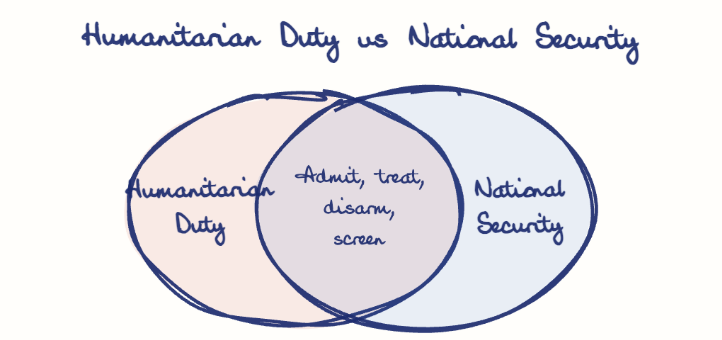
Ashok should admit the civilians for medical care and shelter, disarm and separately hold the soldiers, and report through any channel, leaving their final status to the Centre. NHRC v State of Arunachal Pradesh (1996) held that Article 21 protects non-citizens too.
Model answer
Ghissu Editorial · Verified 4 Oct 2026 · 302 words
(i) CONFRONT [Strict-Legal]
Sealing the border protects sovereignty but is Moral Myopia toward the injured.
(ii) CAPITULATE [Empathetic-Humanitarian]
Letting all in, soldiers included, admits armed men unchecked.
(iii) EVADE [Procedural-Evasive]
Waiting for orders is Conscience Laundering through Hierarchy.
(iv) COMPROMISE [Compromised-Hybrid]
Admitting only women and children splits families.
(v) RECONCILE ✓ [Balanced]
Admit civilians for care, disarm and hold soldiers, report at once (recommended).
Orders vs urgency
Hierarchy expects instructions, but Apaddharma demands action now.
No refugee law vs right to life
India has not signed the 1951 Convention, yet NHRC v State of Arunachal Pradesh (1996) [case] extended Article 21 to non-citizens.
Lives first, report fast
Treat the injured, shelter civilians as Mizoram did after the 2021 coup [current event], and report by wireless.
Disarm and log
Collect and record weapons at the zero line.
Separate and verify
Hold them apart from civilians and check with Assam Rifles whether they are deserters or rebels.
Humane custody, central decision
Treat them humanely and leave return to the Centre, as with the Myanmar soldiers repatriated from Mizoram in 2024 [current event].
This model answer is indicative and the model can make mistakes; please verify key facts independently.
Practise this question
1Get the answer sheet
Sized for this question.
2Write your answer
Timed, by hand.
3Get it marked
Your score and what to fix.
This chapter in the exam
International and Diplomatic Dilemmas3 questions
Asked in 3 of 14 sittings since 2013
- 2026Ajit has been recently promoted as the Head of the Department of Weapon Sales (DWS) in the Ministry of Defence Production (MDP). His charter of duties includes international sales of weapons produced domestically by MDP. In two recent wars, MDP weapons have performed admirably, resulting in many countries showing interest in buying them, particularly long-range artillery and missiles. Country A and country B have asked for these weapons. However, production constraints restrict DWS to accept only one purchase order. Country A is a developing nation with a sound technology base. MDP is planning R&D collaboration with it for the next generation of weapons. It is not part of any security alliance and needs weapons for protection from a troublesome neighbour. It seeks a large acquisition on a long-term loan. Country B is also a developing nation. Military strength is its priority, with the military budget often ingressing into allocations for human resources and infrastructure development. It is in security alliance with a superpower who has a large military base there and periodically allots it financial grants. It is a member of an economic bloc with which the government is currently negotiating a free trade agreement. It is not a signatory of NPT but possesses smaller nuclear weapons and delivery systems. It supports some guerrilla forces abroad. It has sought a smaller acquisition and is prepared to make some advance payment. It is currently negotiating arms purchases from another nation too. Ajit discussed this case with his counterparts in the related departments. Therein, the significant economic benefits, employment generation and stronger diplomatic relations arising from this sale were highlighted. It was also emphasized that refusing the deal could result in country B purchasing weapons from some other supplier. Ajit was aware that in arms sales, due diligence at each stage was pivotal to ensure conformity to national policy and international treaties. (a) Discuss the options available to Ajit. Which option should he select and why? (b) How can Ajit balance nation's economic and strategic interests with ethical considerations?
- 2020The Chairman of Bharat Missiles Ltd (BML) was watching a program on TV wherein the Prime Minister was addressing the nation on the necessity of developing a self-reliant India. He subconsciously nodded in agreement and smiled to himself as he mentally reviewed BML's journey in the past two decades. BML had admirably progressed from producing first generation anti-tank guided missiles (ATGMs) to designing and producing state of the art ATGM weapon systems that would be the envy of any army. He sighed in reconciliation with his assumptions that the government would probably not alter the status quo of a ban on export of military weaponry. To his surprise, the very next day he got a telephone call from the Director General, Ministry of Defence, asking him to discuss the modalities of increasing BML production of ATGMs as there is a possibility of exporting the same to a friendly foreign country. The Director General wanted the Chairman to discuss the details with his staff at Delhi next week. Two days later, at a press conference, the Defence Minister stated that he aims to double the current weapons export levels within five years. This would give an impetus to financing the development and manufacture of indigenous weapons in the country. He also stated that all indigenous arms manufacturing nations have a very good record of international arms trade. As Chairman of BML, what are your views on the following points? (a) As an arms exporter of a responsible nation like India, what are the ethical issues involved in arms trade? (b) List five ethical factors that would influence the decision to sell arms to foreign governments.
Question from the official UPSC Civil Services (Main) Examination 2025 paper. Answer written by Ghissu's engine and checked against our editorial standards. Found an error? Tell us and we correct it within 48 hours.