2025 · GS Paper 4 · Q6(b) · 10 marks
India is an emerging economic power of the world as it has recently secured the status of fourth largest economy of the world as per IMF projection. However, it has been observed that in some sectors, allocated funds remain either under-utilised or misutilised. What specific measures would you recommend for ensuring accountability in this regard to stop leakages and gaining the status of third largest economy of the world in near future?
In short
Stopping leakages needs accountability at every stage: outcome budgeting, just-in-time releases through SNA-SPARSH, a digital trail via DBT and GeM, and social audits and audit follow-up with personal liability. The CAG found 41,002 utilisation certificates worth ₹16,761 crore outstanding in a few ministries in March 2024.
Model answer
Ghissu Editorial · Verified 4 Oct 2026 · 279 words
India became the fourth largest economy in 2025 on IMF projections, which place it third by about 2028. Yet the CAG found 41,002 utilisation certificates worth ₹16,761 crore outstanding in scientific and environmental ministries alone in March 2024.
Accountability Before and During Spending
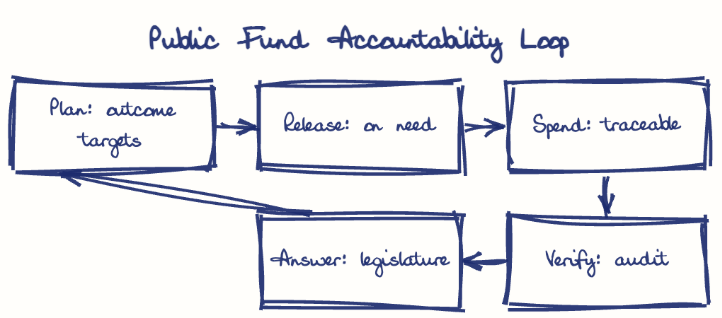
Public Fund Accountability Loop → Plan: outcome targets → Release: on need → Spend: traceable → Verify: audit → Answer: legislature
1. Outcome-based budgeting: Allocations tied to targets under NITI Aayog DMEO's Output-Outcome Monitoring Framework make ministries answer for results. 2. Just-in-time release: SNA-SPARSH (2023) releases scheme funds only when payment falls due, ending idle balances like the ₹122.75 crore the Coal Controller's Organisation parked in a current account (CAG, 2025). 3. Technology against leakage: DBT via the JAM trinity, geo-tagged assets and GeM procurement remove middlemen and leave a digital trail for every rupee. 4. Absorptive capacity: Funds should go only to ready projects with trained staff and cleared land, so money is neither surrendered nor rushed out in March.
Social audit
MGNREGA's Section 17 and Meghalaya's 2017 social audit law let beneficiaries verify spending and expose ghost works.
Audit with follow-through
Time-bound action-taken notes to the Public Accounts Committee and personal liability for avoidable losses would clear the backlog of unanswered audit paragraphs.
Watchdogs and stewardship
An empowered Lokpal and whistle-blower protection make concealment costly, while Mission Karmayogi training instils fiduciary stewardship, treating public money as a trust for citizens.
This model answer is indicative and the model can make mistakes; please verify key facts independently.
Practise this question
1Get the answer sheet
Sized for this question.
2Write your answer
Timed, by hand.
3Get it marked
Your score and what to fix.
This chapter in the exam
Utilization of public funds2 questions
Asked in 2 of 14 sittings since 2013
Question from the official UPSC Civil Services (Main) Examination 2025 paper. Answer written by Ghissu's engine and checked against our editorial standards. Found an error? Tell us and we correct it within 48 hours.