2026 · GS Paper 1 · Q4 · 10 marks
What is the Fujiwara effect? Explain its impact on the movement and intensity of tropical cyclones.
In short
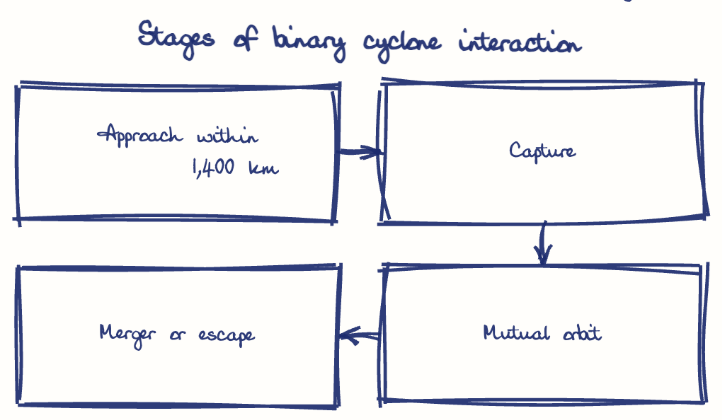
The Fujiwara effect is the mutual rotation of two cyclones within roughly 1,400 km of each other, which bends, stalls or loops their tracks and can weaken, absorb or merge them. Typhoon Parma looped over Luzon in 2009 under Melor's influence, and Hinnamnor absorbed Gardo in 2022.
Model answer
Ghissu Editorial · Verified 4 Oct 2026 · 277 words
Mutual orbit
The pair rotates around a common centroid, anticlockwise in the Northern Hemisphere, pulling each storm off the track its steering winds would give.
Larger storm dominates
The centroid lies near the bigger storm, so the smaller one swings around it like a satellite.
Stalled and looping tracks
Typhoon Parma (2009), held back by Typhoon Melor, lingered over northern Luzon and caused prolonged flooding.
Forecast uncertainty
Small changes in separation decide whether the pair merges or escapes, so binary storms widen track errors.
Absorption and merger
The dominant cyclone can draw in the weaker one's circulation, as Typhoon Hinnamnor absorbed Tropical Storm Gardo in 2022.
Shear and weakening
Outflow from the larger storm imposes vertical wind shear that disrupts the smaller one's warm core.
Competition for energy
Two storms over the same warm sea compete for heat and moisture.
Occasional strengthening
A merger can sometimes produce a larger, longer-lived system that raises the stakes for coastal warning.
This model answer is indicative and the model can make mistakes; please verify key facts independently.
Practise this question
1Get the answer sheet
Sized for this question.
2Write your answer
Timed, by hand.
3Get it marked
Your score and what to fix.
This chapter in the exam
Climate12 questions
Asked in 9 of 14 sittings since 2013
- 2026"Tundra regions are ecologically fragile but economically important." Examine this statement critically.
- 2025How are climate change and the sea level rise affecting the very existence of many island nations? Discuss with examples.
All 12 questions, sorted by sub-topic, with model answers and practice.
Question from the official UPSC Civil Services (Main) Examination 2026 paper. Answer written by Ghissu's engine and checked against our editorial standards. Found an error? Tell us and we correct it within 48 hours.