2026 · GS Paper 3 · Q18 · 15 marks
"Community participation is the cornerstone of effective disaster management". Analyse this statement with suitable examples from India. Also discuss the challenges to community participation and measures to strengthen it. (Answer in 250 words)
In short
Community participation is the cornerstone of disaster management because locals warn, rescue and rebuild before and after the state arrives, though top-down structures, exclusion and thin capacity limit it. Odisha's village-level preparedness cut cyclone deaths from about 10,000 in 1999 to almost zero in Yaas (2021).
Model answer
Ghissu Editorial · Verified 4 Oct 2026 · 298 words
Golden-hour response
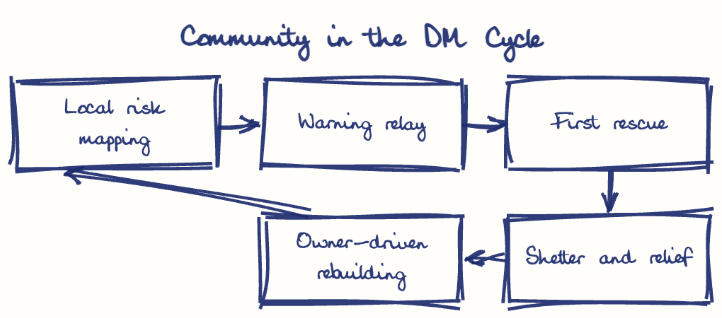
In the 2018 Kerala floods, fishermen with their own boats rescued tens of thousands before formal teams reached them.
Last-mile warning
Village volunteers and shelters helped Odisha cut cyclone deaths from about 10,000 in 1999 to almost zero in Cyclone Yaas (2021), as an NIDM study (2025) records.
Traditional knowledge
The Onge and Jarawa of the Andamans read the receding sea in 2004 and moved to high ground with few or no losses.
Faster recovery
Owner-driven reconstruction after the 2001 Bhuj earthquake rebuilt homes faster than contractor housing.
Top-down architecture
The DM Act, 2005 builds authorities down to districts but leaves panchayats only a generic 'local authority' role.
Exclusion
Women, Dalits and persons with disabilities are often missing from village task forces and relief lists.
Thin capacity
Volunteers lack refresher training, kits and insurance, and urban anonymity weakens neighbourhood networks.
Panchayat DM plans
Build village disaster plans into Gram Panchayat Development Plans with untied funds.
Scale Aapda Mitra
Expand NDMA's trained volunteer cadre with insurance and equipment.
Inclusive drills
Make SHGs, schools and NSS units regular partners in mock drills.
This model answer is indicative and the model can make mistakes; please verify key facts independently.
Practise this question
1Get the answer sheet
Sized for this question.
2Write your answer
Timed, by hand.
3Get it marked
Your score and what to fix.
This chapter in the exam
Disaster Management Framework & Institutions1 question
Asked in 1 of 14 sittings since 2013
Question from the official UPSC Civil Services (Main) Examination 2026 paper. Answer written by Ghissu's engine and checked against our editorial standards. Found an error? Tell us and we correct it within 48 hours.