2026 · GS Paper 4 · Q3(b) · 10 marks
In what ways can an Indian Administrative Officer apply Gandhi's notion of 'trusteeship' to ensure fairness in governance?
In short
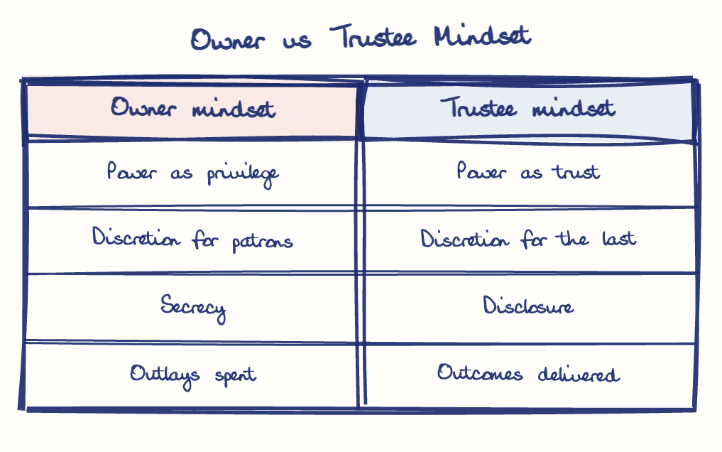
An IAS officer applies Gandhi's trusteeship by treating public money, discretion and information as held in trust, using them transparently and for the poorest and future generations. The public trust doctrine in M.C. Mehta v. Kamal Nath (1997) makes the state a trustee of natural resources.
Model answer
Ghissu Editorial · Verified 4 Oct 2026 · 282 words
Public money as trust
Open procurement through the Government e-Marketplace (2016) ensures no vendor is favoured.
Reasoned discretion
Recording reasons keeps choices non-arbitrary, which E.P. Royappa (1974) made the core of Article 14.
Information for the people
Proactive disclosure under Section 4 of the RTI Act, 2005 lets beneficiaries check fairness.
No personal gain
Declaring assets and conflicts under the AIS (Conduct) Rules, 1968 keeps the trustee from becoming a beneficiary.
Antyodaya targeting
Gandhi's Talisman guides the Aspirational Districts Programme (2018), which focuses on 112 backward districts.
Commons for posterity
M.C. Mehta v. Kamal Nath (1997) made the state trustee of natural resources, so an officer must refuse their private diversion.
People as co-owners
MGNREGA social audits, institutionalised by Andhra Pradesh's SSAAT, let villagers correct unfair exclusion, while CSR funds under Section 135 of the Companies Act, 2013 can be aligned with district priorities.
This model answer is indicative and the model can make mistakes; please verify key facts independently.
Practise this question
1Get the answer sheet
Sized for this question.
2Write your answer
Timed, by hand.
3Get it marked
Your score and what to fix.
This chapter in the exam
Contributions of moral thinkers and philosophers from India23 questions
Asked in 13 of 14 sittings since 2013
- 2025What do each of these quotations convey to you in the present context? "Those who in trouble untroubled are, Will trouble trouble itself." – Thiruvalluvar
- 2025What do each of these quotations convey to you in the present context? "The strength of a society is not in its laws, but in the morality of its people." – Swami Vivekananda
All 23 questions, sorted by sub-topic, with model answers and practice.
Question from the official UPSC Civil Services (Main) Examination 2026 paper. Answer written by Ghissu's engine and checked against our editorial standards. Found an error? Tell us and we correct it within 48 hours.