2026 · GS Paper 4 · Q7 · 20 marks
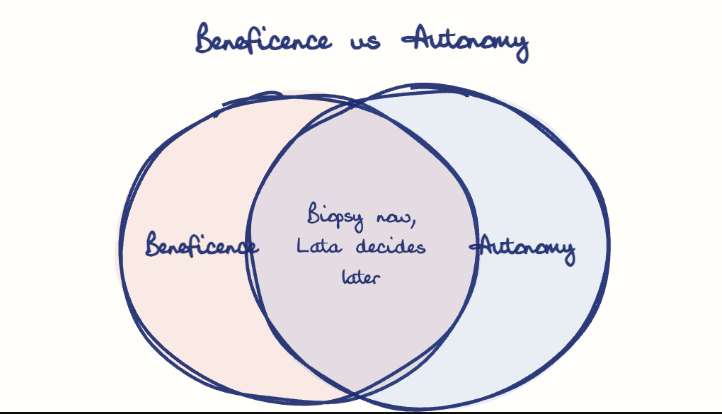
Lata, a mother of two children, was admitted to a hospital for acute abdominal pain. Her sister-in-law, Sujatha, accompanied her. Dr. Mansi examined Lata and recommended a diagnostic laparoscopy. Lata's consent was taken to conduct the medical procedure under general anesthesia. During the laparoscopy, Dr. Mansi's team discovered a tumor in Lata's uterus. A closer examination suggested that the tumor could be malignant. One option before Dr. Mansi was to extract a sample for biopsy. In that case, if the tumor was malignant, Lata would have to undergo another surgery for removal of the uterus. An alternative was to remove the uterus immediately. Dr. Mansi had to take a quick decision. As Lata was under general anesthesia, Dr. Mansi explained the situation to Sujatha. Sujatha agreed with Dr. Mansi's recommendations for a hysterectomy, wherein Lata's uterus would be removed to avoid the risk and pain of undergoing another surgery. Dr. Mansi removed Lata's uterus after receiving Sujatha's consent in writing. Lata was informed of this the next day. She was very upset and felt betrayed as she had not consented to the removal of her uterus. Lata complained to the police who tried to convince her that Dr. Mansi had acted with good intention to help a patient. Sujatha was of the same opinion, however Lata was not convinced and decided to approach the court. (a) Discuss the ethical issues involved in this case. (b) Discuss the moral conduct of the doctor in this situation.
In short
Dr. Mansi acted in good faith but ethically and legally erred, because she removed Lata's uterus without her consent when no emergency existed and a biopsy was possible. Samira Kohli v Prabha Manchanda (2008) held that consent to a diagnostic procedure is not consent to therapeutic surgery.
Model answer
Ghissu Editorial · Verified 4 Oct 2026 · 266 words
Consent exceeded
Samira Kohli v Prabha Manchanda (2008) [case] held that consent to a diagnostic procedure is not consent to therapeutic surgery, barring a life-saving emergency.
Invalid proxy
A sister-in-law's signature cannot replace a competent adult's consent.
Bodily and reproductive autonomy
Puttaswamy (2017) [case] and Suchita Srivastava (2009) [case] protect bodily integrity and reproductive choice under Article 21.
Paternalism and police overreach
The uterus is treated as dispensable, as 843 hysterectomies among Beed's sugarcane workers in 2024 show, and the police discouraged a complaint they should have recorded.
Good faith
Dr. Mansi acted without malice and took written consent to spare Lata a second surgery.
No emergency
The tumour was only possibly malignant and a biopsy was possible, so necessity did not apply.
Paternalism
Deciding for Lata treated her as a means, not an end, failing Kant's respect for persons.
Late disclosure
Telling her the next day without counselling breached trust and caused the betrayal Lata felt.
This model answer is indicative and the model can make mistakes; please verify key facts independently.
Practise this question
1Get the answer sheet
Sized for this question.
2Write your answer
Timed, by hand.
3Get it marked
Your score and what to fix.
This chapter in the exam
Social Sector Dilemmas7 questions
Asked in 5 of 14 sittings since 2013
- 2026Vikas is a government officer with over a decade of service in public administration. He has recently moved as the District Collector (DC) of Nainipura, a remote hilly district bordering a forest. Due to Nainipura's low levels of economic development, one of his major duties is to ensure proper functioning of the public distribution system (PDS) amongst the economically weaker sections (EWS). During his on-site visits, Vikas was apprised of a typical administrative challenge in operating the PDS. To prevent leakages, all distributors were required to carry out real-time biometric identification of the beneficiaries, whose fingerprints were tallied with identity card records. This was creating problems as the operating system sometimes rejected fingerprint matching in the cases of growing children, manual labourers and senior citizens. The problem was further compounded in periods of low WiFi connectivity. The distributors, in such cases, resorted to personal discretion when they could identify the recipient. Vikas had to address this problem on priority. Strictly adhering to government regulations would ensure fiscal probity but would greatly trouble the proposed beneficiary, i.e., EWS. It may even impinge on their fundamental right to life as per Article 21 of the Constitution. Conversely, leaving the resolution solely to the discretion of the distributors could lead to misuse and leakages. (a) What are the options open to Vikas? How should he balance fiscal probity with empathy towards the designated beneficiaries? (b) Discuss the ethics of using technology as a gatekeeper for welfare schemes.
- 2021You are the Vice Principal of a reputed degree college affiliated to a leading university. One of the final year students has complained to you that he has been, of late, threatened and stalked by some of the college students. It was also reported that some students of the college were pressurizing him to get the answers of assessment papers leaked in his favour. Further enquiry by you revealed that two students of the final year wanted to get through all the papers of the final semester with high grades so that they can get admission in a premier management institute for a post-graduate programme. Additionally, a senior lecturer of the college was personally helping these students in this act. This senior lecturer also happens to be close to the management. One of the students was son of a local politician who was responsible in getting college affiliated to the present reputed university. The second student was son of a local businessman who has donated maximum funds for running of the college. You immediately informed the management regarding this unfortunate incident. The management told you to resolve the issue with flying squad at any cost. They further said that such incident will not only tarnish the image of the college but also the politician and businessman are very important personalities for the functioning of the college. You were also given hint that your further promotion to Principal depends on your capability in resolving this issue with flying squad. In the meantime, you were intimated by your administrative officer that certain members of the student union are protesting outside the college gate against the senior lecturer and the students involved in this incident and demanding strict action against defaulters. (a) Discuss the ethical issues involved in the case. (b) Critically examine the options available with you as Vice Principal. What option will you adopt and why?
All 7 questions, sorted by sub-topic, with model answers and practice.
Question from the official UPSC Civil Services (Main) Examination 2026 paper. Answer written by Ghissu's engine and checked against our editorial standards. Found an error? Tell us and we correct it within 48 hours.