2026 · GS Paper 4 · Q8 · 20 marks
Ravi is a senior police officer with vast experience in riot control and cyber-policing. Since one year, he has been the Superintendent of Police (SP) of a district with a history of frequent rioting. Last year, Ravi had sought installation of an AI enabled software for predictive policing. This system has been operational for approximately six months. This new system employs advanced algorithms for capturing the biometric data of persons in a crowd and swiftly relating it to a data library. This has enabled the police to identify the persons involved in various crimes. The system has identified an immigrant and low-income neighbourhood as a centre for gang violence and drug trafficking. Aided by this AI analysis, the local police has focused its patrolling, preventive detentions and establishing checkpoints. Consequently, public order and law enforcement has visibly improved. Last week, some community leaders, civil rights lawyers and human rights activists visited Ravi's office. They submitted a memorandum that the new system is faulty as it is based on incorrect historical data caused by social biases and discriminatory policing. The memorandum also alleges that the increased surveillance has created a climate of tension amongst residents. This feeling is aggravated by the fact that the residents are not aware of the data noted against their names. (a) What are the ethical issues including biases involved in the use of AI in data-driven policing? (b) Place yourself in Ravi's role and discuss the alternatives available. Justify the action that optimises compliance with ethics.
In short
AI-driven policing here raises historical-data bias, a self-reinforcing feedback loop, privacy and opacity concerns, so Ravi should suspend AI-only actions, audit the system and restore community trust. Puttaswamy (2017) requires such surveillance to be lawful, necessary and proportionate.
Model answer
Ghissu Editorial · Verified 4 Oct 2026 · 301 words
Historical data bias
The model learns from past arrests, not past crime, so over-policed areas look crime-prone, as Lum and Isaac's 2016 Oakland study showed.
Feedback loop and automation bias
More patrols record more offences, which the model reads as proof, while officers trust the machine over their judgment.
Privacy and opacity
Mass facial capture fails the Puttaswamy (2017) proportionality test, and residents cannot see or contest their data.
(i) CONFRONT [Strict-Legal]
Act on every flag; visible order, but Motivated Blindness.
(ii) CAPITULATE [Empathetic-Humanitarian]
Scrap the system; quick relief, but Moral Escapism.
(iii) EVADE [Procedural-Evasive]
Forward and wait, which is Conscience Laundering through Hierarchy.
(iv) COMPROMISE [Compromised-Hybrid]
Cut patrols but leave the bias untouched.
(v) RECONCILE ✓ [Balanced]
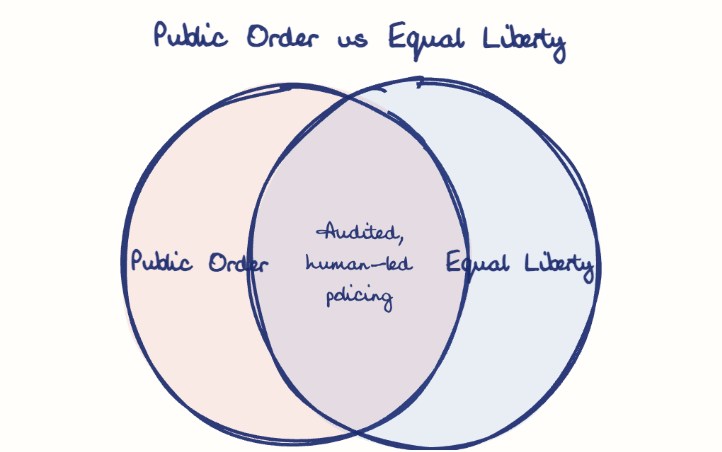
Suspend AI-only actions, audit the system and police with consent (recommended).
Human in the loop and audit
Every stop needs an officer's recorded reason, and an independent audit under NITI Aayog's Responsible AI principles (2021) [committee/report] purges biased data.
Transparency and trust
Tell residents what is held and how to correct it, and form mohalla committees as Suresh Khopde [officer] did in Bhiwandi.
This model answer is indicative and the model can make mistakes; please verify key facts independently.
Practise this question
1Get the answer sheet
Sized for this question.
2Write your answer
Timed, by hand.
3Get it marked
Your score and what to fix.
This chapter in the exam
Police and Law Enforcement Dilemmas6 questions
Asked in 5 of 14 sittings since 2013
- 2024Raman is a senior IPS officer and has recently been posted as D.G. of a state. Among the various issues and problems/challenges which needed his immediate attention, the issue relating to recruitment of unemployed youth by an unknown terrorist group, was a matter of grave concern. It was noted that unemployment was relatively high in the state. The problem of unemployment amongst graduates and those with higher education was much more grave. Thus they were vulnerable and soft targets. In the review meeting taken by him with senior officers of DIG Range and above, it came to light that a new terrorist group has emerged at the global level. It has launched a massive drive to recruit young unemployed people. Special focus was to pick young people from a particular community. The said organisation seemed to have the clear objective of utilising/using them for carrying out militant activities. It was also gathered that the said (new) group is desperately trying to spread its tentacles in his state. A definite/reliable intelligence tip was received by the State CID and Cyber Cell that a large number of such unemployed youth have already been contacted by the terrorist outfit/group through social media and local communal organisations and other contacts. The need of the hour was to act swiftly and to check these elements/designs before they assume serious proportions. Discrete inquiries made by the police, through the Cyber Cell, revealed that good numbers of unemployed youth are very active on Facebook, Instagram and Twitter. On an average, many of them were spending 6-8 hours each day, using electronic devices/internet, etc. It also came to light that such unemployed youth were showing sympathy and endorsing the messages received from certain persons, allegedly the contact persons of that global terrorist group. Their social media accounts revealed their strong affinity to such groups inasmuch as many of them started forwarding anti-national tweets on their WhatsApp and Facebook, etc. It seemed that they succumbed to their ploy and started propagating secessionist ideology. Their posts were hyper-critical of the government's initiatives, policies and subscribing to extreme beliefs and promoting extremism. (a) What are the options available to Raman to tackle the above situation? (b) What measures would you suggest for strengthening the existing set-up to ensure that such groups do not succeed in penetrating and vitiating the atmosphere in the state? (c) In the above scenario, what action plan would you advise for enhancing the intelligence gathering mechanism of the police force?
- 2024With multipronged strategy of the Central and State Governments specially in the last few years, the Naxal problem has been resolved to a large extent in the affected states of the country. However, there are a few pockets in certain states where Naxal problem still persists, mainly due to involvement of foreign countries. Rohit is posted as SP (Special Operations) for the last one year, in one of the districts which is still affected by the Naxal problem. The district administration has taken a lot of developmental works in the recent past in the Naxal affected areas to win the hearts and minds of the people. Over a period of time, Rohit has established an excellent intelligence network to get the real time information regarding the movement of Naxal cadre. To instill confidence in the public and have moral ascendancy over the Naxalites, a number of cordons and search operations are being conducted by the police. Rohit, who himself was leading one of the contingents got a message though his intelligence source that about ten hard core Naxalites were hiding in a particular village with sophisticated weapons. Without wasting any time, Rohit reached the target village with his team and laid out a foolproof cordon and started carrying out a systematic search. During the search, his team managed to overpower all the Naxalites along with their automatic weapons. However, in the meantime, more than five hundred tribal women surrounded the village and started marching towards the target house. They were shouting and demanding the immediate release of insurgents since they are their protectors and saviours. The situation on the ground was becoming very critical as the tribal women were extremely agitated and aggressive. Rohit tried to contact his superior officer, IG (Special Operations) of the state on the radio set and on mobile phone, but failed to do so due to poor connectivity. Rohit was in great dilemma since out of the Naxalites apprehended, two were not only hard core top insurgents with prize money of ten lakhs on their heads, but were also involved in a recent ambush on the security forces. However, if he did not release the Naxalites, the situation could get out of control since the tribal women were aggressively charging towards them. In that case, to control the situation Rohit might have to resort to firing which may lead to valuable loss of lives of civilians and would further complicate the situation. (a) What are the options available with Rohit to cope with the situation? (b) What are the ethical dilemmas being faced by Rohit? (c) Which of the options, do you think, would be more appropriate for Rohit to adopt and why? (d) In the present situation, what are the extra precautionary measures to be taken by the police in dealing with women protesters?
All 6 questions, sorted by sub-topic, with model answers and practice.
Question from the official UPSC Civil Services (Main) Examination 2026 paper. Answer written by Ghissu's engine and checked against our editorial standards. Found an error? Tell us and we correct it within 48 hours.