Explain the important objectives of the 10th Five Year Plan.
In short
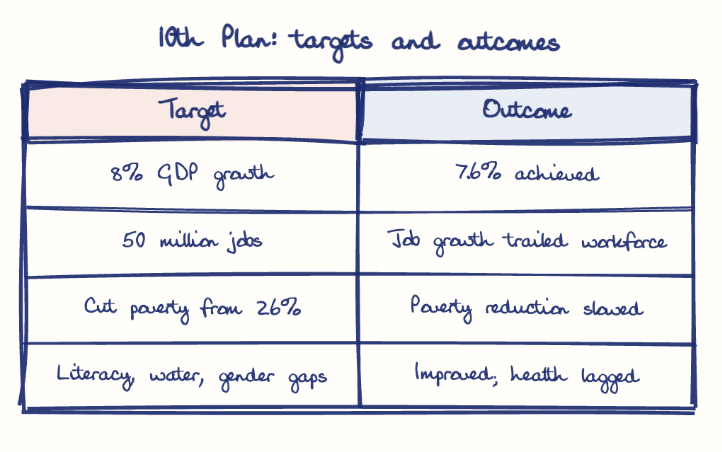
The 10th Five Year Plan (2002-2007) aimed for 8% annual GDP growth to double per capita income within a decade and create 50 million jobs. It also sought to cut poverty by 5 percentage points by 2007 and to decentralise planning through states and Panchayati Raj Institutions.
Model answer
Ghissu Editorial · Verified 4 Oct 2026 · 273 words
Growth and Income Doubling
Targeted 8% GDP growth to double per capita income, enhancing productive capacity and living standards.
Employment Generation
Emphasized creating 50 million jobs, especially in labour-intensive sectors, to leverage the demographic dividend.
Poverty Reduction and Social Equity
Aimed to cut the poverty ratio of about 26% by 5 percentage points by 2007, ensuring growth benefits reached poor and marginalized groups.
Decentralized Planning and Governance
Advocated greater Panchayati Raj and state involvement for cooperative federalism and accountability.
Growth Performance
Achieved 7.6% GDP growth, led by industry and services; agriculture showed modest gains amid rural challenges.
Poverty and Employment Gaps
Poverty reduction lagged due to regional disparities and skill mismatches; employment growth was insufficient.
Fiscal Consolidation
Focused on reducing revenue deficits via tax reforms and subsidy rationalization for sustainable investment.
Social Indicators
Literacy and gender gaps improved; rural infrastructure lagged, especially in Rayalaseema.
Skill Development
Targeted training aligned with industry needs to reduce structural unemployment.
Rural Infrastructure
Irrigation and rural connectivity, as under Bharat Nirman (2005), to boost agriculture, especially in Rayalaseema.
Inclusive Growth Policies
Wider safety nets, as NREGA (2005) began to provide, including in Andhra Pradesh.
Governance
Empower local bodies with fiscal autonomy for better service delivery.
This model answer is indicative and the model can make mistakes; please verify key facts independently.
Sources
Practise this question
1Get the answer sheet
Sized for this question.
2Write your answer
Timed, by hand.
3Get it marked
Your score and what to fix.
This chapter in the exam
Major Challenges of Indian Economy26 questions
Asked in 8 of 8 sittings since 2008
Most tested: Unemployment and employment structure
- 2025Discuss how infrastructure bottlenecks hinder the growth of the Indian Manufacturing sector. What steps can be taken to address them?
- 2025Analyse the factors contributing to India's Current Account Deficit (CAD) and unfavourable Balance of Payments (BoP) and discuss their implications for the Indian economy.
All 26 questions, sorted by sub-topic, with model answers and practice.
Question from the official APPSC Group-I Mains 2008 paper. Answer written by Ghissu's engine and checked against our editorial standards. Found an error? Tell us and we correct it within 48 hours.