Explain the problems in measuring national income.
In short
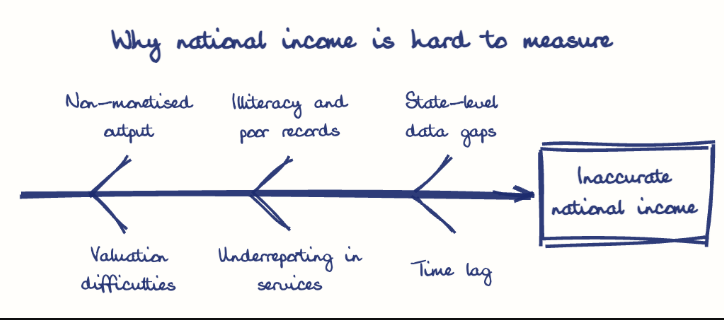
Measuring national income in India is hard because of non-monetised farm output, a large informal sector, poor record-keeping, under-reported service incomes and difficulties valuing inventories and depreciation. Missing distribution data, weak state-level statistics such as in Andhra Pradesh, and long time lags with repeated revisions further distort policy.
Model answer
Ghissu Editorial · Verified 4 Oct 2026 · 261 words
Incomplete Occupational Classification1
Informal and diverse economic activities, such as small-scale household enterprises in Andhra Pradesh, lack clear categorisation, making aggregation and sectoral analysis difficult.
Poor Record-Keeping and Under-Reporting
Illiteracy and lack of incentives in Andhra Pradesh’s rural and informal sectors lead to guesswork in output estimation. Professionals like doctors and teachers often under-report income, distorting service sector GDP figures.
Inequality Misestimation
Absence of detailed income distribution data limits targeted poverty alleviation, especially in drought-prone Rayalaseema, affecting inclusive growth efforts.
ACNAS Recommendations
Implement the Advisory Committee on National Account Statistics’ suggestions by incorporating new data sources such as the Annual Survey of Unincorporated Sector4 Enterprises and the Periodic Labour Force Survey annually to improve data quality.
State Capacity Building
Strengthen statistical systems in Andhra Pradesh to generate timely and accurate industrial and agricultural data, reducing reliance on outdated surveys and improving policy relevance.
This model answer is indicative and the model can make mistakes; please verify key facts independently.
Practise this question
1Get the answer sheet
Sized for this question.
2Write your answer
Timed, by hand.
3Get it marked
Your score and what to fix.
This chapter in the exam
Major Challenges of Indian Economy26 questions
Asked in 8 of 8 sittings since 2008
Most tested: Unemployment and employment structure
- 2025Discuss how infrastructure bottlenecks hinder the growth of the Indian Manufacturing sector. What steps can be taken to address them?
- 2025Analyse the factors contributing to India's Current Account Deficit (CAD) and unfavourable Balance of Payments (BoP) and discuss their implications for the Indian economy.
All 26 questions, sorted by sub-topic, with model answers and practice.
Question from the official APPSC Group-I Mains 2008 paper. Answer written by Ghissu's engine and checked against our editorial standards. Found an error? Tell us and we correct it within 48 hours.