What are the direct and indirect taxes levied by the government of Andhra Pradesh?
In short
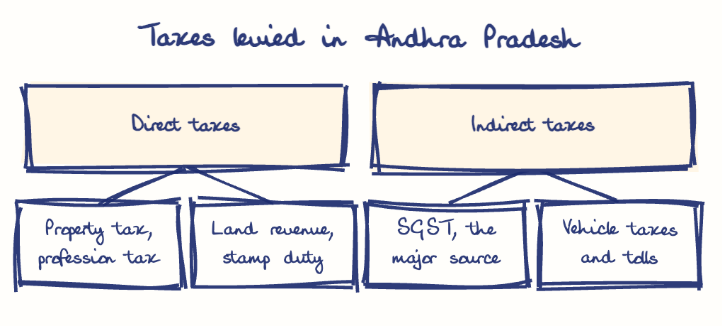
Andhra Pradesh levies direct taxes such as property tax, profession tax, land revenue and stamp duty, and indirect taxes led by SGST, with vehicle and toll levies. SGST replaced VAT and entry tax after GST, while a CAG audit found ₹1,806 crore revenue impact from tax and land department lapses.
Model answer
Ghissu Editorial · Verified 4 Oct 2026 · 278 words
Andhra Pradesh321’s fiscal strategy relies heavily on direct and indirect taxes to support welfare schemes and infrastructure amid a 12% GSDP growth forecast for 2026-27.
Direct Taxes Levied by Andhra Pradesh
1. Property Tax and Land Revenue: Property tax under the Andhra Pradesh Panchayat Act, 1994, and land revenue plus stamp duty on property transactions are major direct taxes funding urban and rural infrastructure.
2. Tax on Trade and Professions: This direct tax targets non-agricultural economic activities, periodically revised to reflect economic realities.
3. Revenue Leakages Highlighted by CAG: The 2021-22 CAG audit revealed ₹1,806 crore revenue impact due to underassessment and inefficiencies in tax and land departments.
State Goods and Services Tax (SGST)
SGST is the primary indirect tax post-GST implementation, replacing VAT, entry tax, and entertainment tax, levied alongside Central GST but accruing wholly to the state.
Entry and Entertainment Taxes
Despite GST repeal of entry tax, some local entry taxes remain; entertainment and luxury taxes contribute to local revenues but have declined under GST.
Vehicle and Toll Taxes
These indirect taxes fund transport infrastructure, including projects like the Visakhapatnam-Chennai industrial corridor.
Enhance Compliance and Broaden Tax Base
Strengthen audit mechanisms and formalize informal sectors to improve direct tax collection, especially property tax in urbanizing areas like Amaravati.
Optimize GST Administration and Fiscal Discipline
Improve coordination with the central government to curb evasion and increase capital expenditure, which has sharply declined.
This model answer is indicative and the model can make mistakes; please verify key facts independently.
Practise this question
1Get the answer sheet
Sized for this question.
2Write your answer
Timed, by hand.
3Get it marked
Your score and what to fix.
This chapter in the exam
Resource mobilization in Andhra Pradesh20 questions
Asked in 8 of 8 sittings since 2008
Most tested: Andhra Pradesh’s revenue sources, central transfers, and resource allocation/resource gap after bifurcation.
- 2025Explain the major sources of budgetary resources for Andhra Pradesh. What are the key challenges the state faces in mobilising adequate financial resources?
- 2023Briefly discuss the impact of bifurcation on the economy of Andhra Pradesh with respect to sectoral changes and resource gap. Provide a brief note on the steps taken by the Government of Andhra Pradesh to mobilize resources.
All 20 questions, sorted by sub-topic, with model answers and practice.
Question from the official APPSC Group-I Mains 2008 paper. Answer written by Ghissu's engine and checked against our editorial standards. Found an error? Tell us and we correct it within 48 hours.