Discuss our national policy on generation and management of intellectual property.
In short
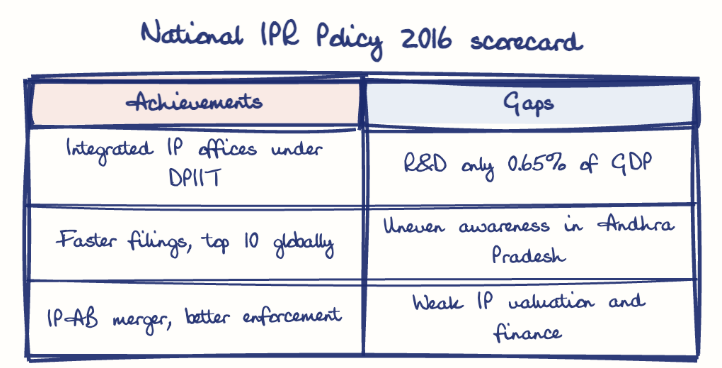
India's National IPR Policy (2016) aims to stimulate innovation by strengthening IP laws, administration, awareness, enforcement and commercialisation in line with TRIPS while protecting public welfare. It integrated IP offices under DPIIT and fast-tracked start-up filings, though R&D spending of about 0.65% of GDP still limits IP generation.
Model answer
Ghissu Editorial · Verified 4 Oct 2026 · 255 words
Legal and Legislative Strengthening
The Novartis AG v. Union of India1 (2013) judgment exemplifies India’s balanced IP laws protecting innovation and access to medicines. Additionally, the modernization of IP laws supports enforcement and adjudication, enhancing protection against infringements.
Awareness and Outreach Gaps
Public IP awareness remains low in Andhra Pradesh, limiting grassroots innovation and commercialization. This is especially evident in rural and semi-urban areas where knowledge about IP benefits is scarce.
R&D Investment Constraints
With R&D expenditure at 0.65% of GDP, sectors like biotechnology face innovation challenges despite digitalization successes like AI-enabled IP searches and expedited patent examination. The Start-Up Intellectual Property Protection Scheme has helped but financing and valuation of IP remain hurdles.
Strengthen Commercialization and Digital Infrastructure
Developing IP valuation frameworks and expanding AI-driven IP management tools for innovators in Andhra Pradesh will improve financing and accessibility. Scaling virtual hearings and digital services will further reduce pendency and support innovators.
This model answer is indicative and the model can make mistakes; please verify key facts independently.
Sources
Practise this question
1Get the answer sheet
Sized for this question.
2Write your answer
Timed, by hand.
3Get it marked
Your score and what to fix.
This chapter in the exam
Intellectual Property Rights; Promotion of Science in AP and India6 questions
Asked in 4 of 8 sittings since 2008
Most tested: Patent-centric IPR understanding and commercialization of intellectual property in India.
- 2025Describe the importance of IPR in academic and industrial research collaborations.
- 2023What are the tools required for the successful commercialization of Intellectual Property Rights in India ? Discuss the role of CIPAM in commercialization of Intellectual Property Rights.
All 6 questions, sorted by sub-topic, with model answers and practice.
Question from the official APPSC Group-I Mains 2008 paper. Answer written by Ghissu's engine and checked against our editorial standards. Found an error? Tell us and we correct it within 48 hours.