Explain the important sectoral changes in post-independence Indian economy with respect to income and work-force.
In short
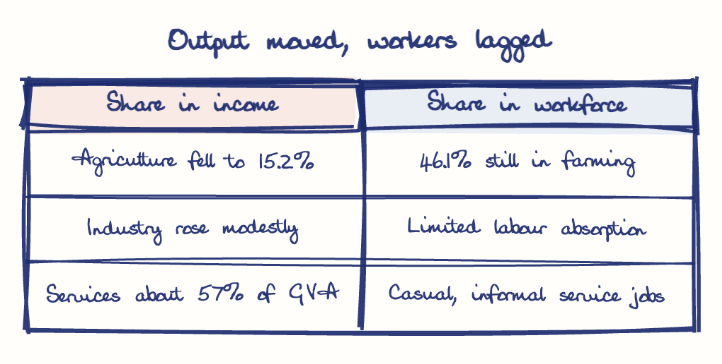
Since independence, agriculture's share has fallen from over 50% to about 15.2% of GVA in 2023-24, while services rose to about 57% and industry grew modestly. The workforce shifted more slowly, with nearly 46% still in agriculture, so structural change is visible in income but incomplete in employment.
Model answer
Ghissu Editorial · Verified 4 Oct 2026 · 264 words
Industrial Growth and Regional Impact
Industry’s GVA share grew modestly post-1990 liberalisation; Andhra Pradesh’s industrial corridors like Visakhapatnam-Chennai have driven manufacturing and higher GSDP growth, with per capita income reaching ₹2,68,653 in 2024-25.
Services Sector Expansion
Services contribute about 57% of GVA, led by IT and finance, but employment remains largely informal and low-productivity.
Rural Non-Farm Economy
Rural non-agricultural activities generate two-thirds of rural income, with rural manufacturing contributing over half of national manufacturing value added.
Wealth Inequality
The top 10% hold ~77% of wealth, reflecting uneven benefits of growth.
Regional Disparities
Andhra Pradesh outperforms national averages, but rural-urban income gaps persist.
Slow Workforce Shift
Nearly 46% remain in agriculture despite output decline, causing underemployment.
Informal Employment Growth
Non-farm and service jobs are often informal or casual, including in Andhra Pradesh.
Female Labour Participation
Female participation is rising but concentrated in informal sectors with wage gaps.
This model answer is indicative and the model can make mistakes; please verify key facts independently.
Practise this question
1Get the answer sheet
Sized for this question.
2Write your answer
Timed, by hand.
3Get it marked
Your score and what to fix.
This chapter in the exam
Major Challenges of Indian Economy26 questions
Asked in 8 of 8 sittings since 2008
Most tested: Unemployment and employment structure
- 2025Discuss how infrastructure bottlenecks hinder the growth of the Indian Manufacturing sector. What steps can be taken to address them?
- 2025Analyse the factors contributing to India's Current Account Deficit (CAD) and unfavourable Balance of Payments (BoP) and discuss their implications for the Indian economy.
All 26 questions, sorted by sub-topic, with model answers and practice.
Question from the official APPSC Group-I Mains 2011 paper. Answer written by Ghissu's engine and checked against our editorial standards. Found an error? Tell us and we correct it within 48 hours.