Describe the analysis of tax devolution from Central Government to Andhra Pradesh Government in the last decade.
In short
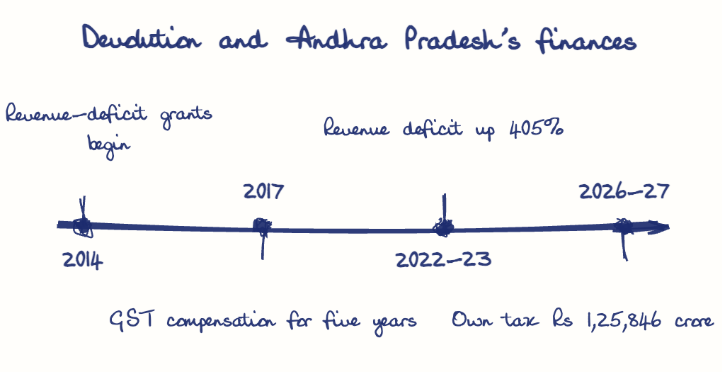
Over the last decade, central tax devolution to Andhra Pradesh moved from post-bifurcation revenue-deficit grants towards a larger formula-based share under the Fourteenth and Fifteenth Finance Commissions, plus GST compensation. Yet the revenue deficit rose 405% in 2022-23 to ₹43,487 crore, showing devolution alone could not close the fiscal gap.
Model answer
Ghissu Editorial · Verified 4 Oct 2026 · 292 words
Post-Bifurcation Fiscal Transfers
After 2014 bifurcation, revenue-deficit grants under the Andhra Pradesh Reorganisation Act stabilized the state’s finances amid Hyderabad’s revenue loss. Transitional support was vital to manage the initial fiscal shock and maintain essential services.
Increasing Share and Own Revenue
Tax devolution increased under Finance Commission formulae, alongside a 28% rise in own tax revenue in 2026-27, indicating fiscal mobilization progress. The introduction of GST in 2017 also influenced revenue flows, with compensation mechanisms benefiting the state’s expanding industrial and service sectors.
Rising Deficits and Revenue Leakages
Despite increased transfers, revenue deficit quadrupled in 2022-23 to ₹43,487 crore; CAG audit (2021-22) exposed ₹1,806 crore revenue leakages in tax and land departments, highlighting governance weaknesses in revenue collection.
Finance Commission Influence
The Fourteenth and Fifteenth Finance Commissions shaped tax devolution formulas, emphasizing population, area, fiscal capacity, and performance-based grants. The Fifteenth Finance Commission introduced incentives for fiscal discipline and improved tax effort.
This model answer is indicative and the model can make mistakes; please verify key facts independently.
Sources
- 1.CAG State Audit Reports · Mar 2026 ↗
- 2.CAG State Audit Reports · Nov 2024 ↗
- 3.Statehood reference documents (Sri Krishna Committee report, AP Reorganisation Act 2014) · Mar 2014 ↗
- 4.CAG State Audit Reports · Sep 2023 ↗
- 5.State Budget Analysis (PRS) · Feb 2025 ↗
- 6.State Budget Analysis (PRS) · Feb 2026 ↗
- 7.CAG State Audit Reports · Mar 2026 ↗
Practise this question
1Get the answer sheet
Sized for this question.
2Write your answer
Timed, by hand.
3Get it marked
Your score and what to fix.
This chapter in the exam
Resource mobilization in Andhra Pradesh20 questions
Asked in 8 of 8 sittings since 2008
Most tested: Andhra Pradesh’s revenue sources, central transfers, and resource allocation/resource gap after bifurcation.
- 2025Explain the major sources of budgetary resources for Andhra Pradesh. What are the key challenges the state faces in mobilising adequate financial resources?
- 2023Briefly discuss the impact of bifurcation on the economy of Andhra Pradesh with respect to sectoral changes and resource gap. Provide a brief note on the steps taken by the Government of Andhra Pradesh to mobilize resources.
All 20 questions, sorted by sub-topic, with model answers and practice.
Question from the official APPSC Group-I Mains 2012 paper. Answer written by Ghissu's engine and checked against our editorial standards. Found an error? Tell us and we correct it within 48 hours.