Discuss briefly the major changes involved in the recent revision in the base year and method of national income accounting.
In short
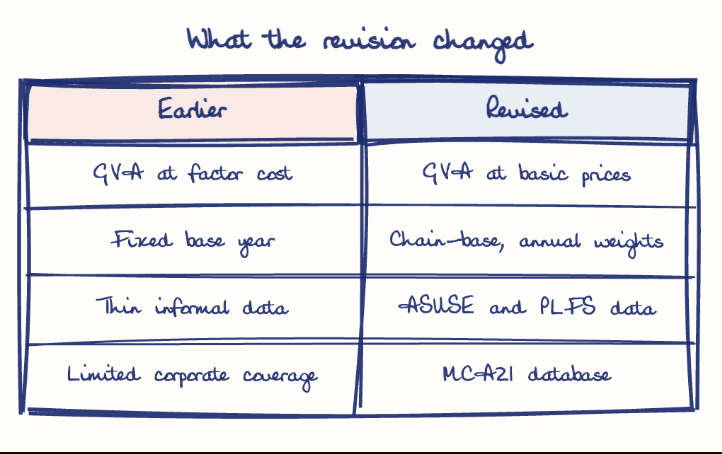
The 2015 revision shifted the base year from 2004-05 to 2011-12, adopted GVA at basic prices and drew on the MCA21 corporate database. Later refinements, guided by ACNAS (2024), add ASUSE and PLFS data, align with SNA 2008 and move toward a chain-base method.
Model answer
Ghissu Editorial · Verified 4 Oct 2026 · 259 words
ACNAS and Sub-Committees
The Advisory Committee on National Account Statistics (ACNAS), formed in June 2024, along with sub-committees like the Sub-committee for Incorporation of New Data Sources, Rates and Ratios4, and Sub-committee for Methodological Improvement, steered the revision process ensuring adherence to SNA 2008 and preparation for SNA 2025.
New Data Sources and Valuation
Integration of ASUSE and PLFS data enhances informal sector coverage; retaining the 2011-12 series' valuation of GVA at basic prices captures production taxes and subsidies more accurately.
Chain-Base Method and Structural Changes
Adoption of chain-base method enables annual updating of weights, reflecting rapid economic shifts such as the gig economy and new industries more promptly.
Corporate and Regional Data Integration
Use of MCA21 database and inclusion of financial sector entities improve output measurement; state-level data, including from Andhra Pradesh, supports targeted development and projects like Polavaram.
Strengthen State Data and Digital Integration
Enhancing state statistical capacity, especially in Andhra Pradesh, and leveraging digital data such as MCA21 and GST returns will improve data granularity and tracking.
Improve Data Dissemination
Aligning with IMF’s SDDS guidelines will ensure timely and transparent release of national accounts5 data.
This model answer is indicative and the model can make mistakes; please verify key facts independently.
Practise this question
1Get the answer sheet
Sized for this question.
2Write your answer
Timed, by hand.
3Get it marked
Your score and what to fix.
This chapter in the exam
Major Challenges of Indian Economy26 questions
Asked in 8 of 8 sittings since 2008
Most tested: Unemployment and employment structure
- 2025Discuss how infrastructure bottlenecks hinder the growth of the Indian Manufacturing sector. What steps can be taken to address them?
- 2025Analyse the factors contributing to India's Current Account Deficit (CAD) and unfavourable Balance of Payments (BoP) and discuss their implications for the Indian economy.
All 26 questions, sorted by sub-topic, with model answers and practice.
Question from the official APPSC Group-I Mains 2016 paper. Answer written by Ghissu's engine and checked against our editorial standards. Found an error? Tell us and we correct it within 48 hours.