Eleventh five year plan identified the weaknesses on the employment front during the period of reforms. Describe them.
In short
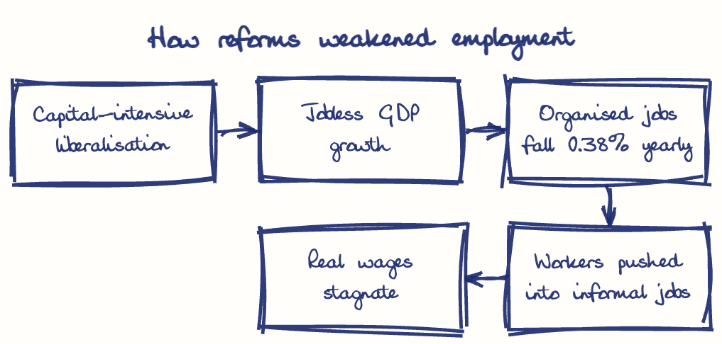
The Eleventh Plan found jobless growth during reforms: daily-status unemployment rose from 7.3% (1999-2000) to 8.3% (2004-05) and organised employment shrank 0.38% a year during 1994-2004. It also flagged dominant low-productivity informal work, stagnant real wages and skill and regional mismatches.
Model answer
Ghissu Editorial · Verified 4 Oct 2026 · 311 words
Decline in Organized Sector Employment
Employment in the organized sector declined at an annual rate of 0.38% during 1994-2004 due to rising capital intensity and outsourcing. This trend frustrated educated youth who expected better formal job opportunities.
Dominance of Informal and Low-Productivity Jobs
Non-agricultural employment grew at 4.7% annually (1999-2005), but mainly in the unorganized sector, dominated by low-productivity self-employment lacking job security and social benefits.
Wage Stagnation and Inequality
Real wages in non-agricultural sectors stagnated during 1999-2005, with organized sector wages stagnating or declining for workers, even as managerial salaries rose sharply, reflecting growing inequality.
Regional Disparities and Structural Mismatches
States like Andhra Pradesh faced skill mismatches and uneven growth; coastal industrial corridors showed promise, but drought-prone areas like Rayalaseema lagged, highlighting regional imbalances.
Promote Labour-Intensive SMEs and Labour Law Reforms
Strengthen policies and credit access for SMEs, especially in Andhra Pradesh, to create quality jobs. Implement labour law reforms balancing flexibility with social security to encourage formal employment growth.
This model answer is indicative and the model can make mistakes; please verify key facts independently.
Practise this question
1Get the answer sheet
Sized for this question.
2Write your answer
Timed, by hand.
3Get it marked
Your score and what to fix.
This chapter in the exam
Major Challenges of Indian Economy26 questions
Asked in 8 of 8 sittings since 2008
Most tested: Unemployment and employment structure
- 2025Discuss how infrastructure bottlenecks hinder the growth of the Indian Manufacturing sector. What steps can be taken to address them?
- 2025Analyse the factors contributing to India's Current Account Deficit (CAD) and unfavourable Balance of Payments (BoP) and discuss their implications for the Indian economy.
All 26 questions, sorted by sub-topic, with model answers and practice.
Question from the official APPSC Group-I Mains 2016 paper. Answer written by Ghissu's engine and checked against our editorial standards. Found an error? Tell us and we correct it within 48 hours.