The proportion of revenue receipts and total budgetary receipts as percentage of GSDP increased during the period 2002-2007 and declined during 2008-14. Explain the factors contributed for such trend.
In short
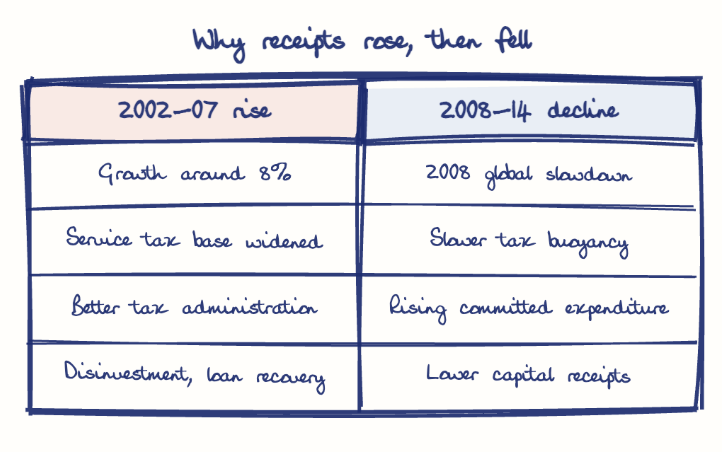
Receipts rose as a share of GSDP in 2002-2007 as growth near 8%, a wider service tax base, Twelfth Finance Commission grants and Andhra Pradesh's Hyderabad boom and 2005 VAT lifted revenue. They fell in 2008-14 with the global financial crisis, rising committed spending and the 2009-14 statehood agitation.
Model answer
Ghissu Editorial · Verified 4 Oct 2026 · 238 words
Strong Economic Growth and Tax Expansion
GDP growth averaged 8%, boosting tax revenues; service tax rate increased from 5% to 12%, coverage expanded from 52 to 98 services, raising receipts.
Fiscal Reforms and Grants
Twelfth Finance Commission enhanced non-plan grants; improved tax administration increased buoyancy; undivided Andhra Pradesh’s Hyderabad-led boom and the 2005 switch to VAT expanded its tax base.
Global Financial Crisis and Fiscal Deficits
The 2008 slowdown reduced tax collections; rising pensions and interest payments crowded out capital expenditure; in Andhra Pradesh the 2009-14 statehood agitation disrupted economic activity.
Slower Tax Buoyancy and Disinvestment
Corporate tax growth slowed amid uncertainty; disinvestment and loan recoveries slowed, lowering non-debt capital receipts.
Growth-Deficit Dynamics and Debt Sustainability
Growth outpaced borrowing costs in 2002-07, improving fiscal health; this gap narrowed in 2008-14, increasing fiscal stress.
Revenue Deficit Impact
Persistent deficits limited capital expenditure, affecting future revenue potential.
This model answer is indicative and the model can make mistakes; please verify key facts independently.
Practise this question
1Get the answer sheet
Sized for this question.
2Write your answer
Timed, by hand.
3Get it marked
Your score and what to fix.
This chapter in the exam
Resource mobilization in Andhra Pradesh20 questions
Asked in 8 of 8 sittings since 2008
Most tested: Andhra Pradesh’s revenue sources, central transfers, and resource allocation/resource gap after bifurcation.
- 2025Explain the major sources of budgetary resources for Andhra Pradesh. What are the key challenges the state faces in mobilising adequate financial resources?
- 2023Briefly discuss the impact of bifurcation on the economy of Andhra Pradesh with respect to sectoral changes and resource gap. Provide a brief note on the steps taken by the Government of Andhra Pradesh to mobilize resources.
All 20 questions, sorted by sub-topic, with model answers and practice.
Question from the official APPSC Group-I Mains 2016 paper. Answer written by Ghissu's engine and checked against our editorial standards. Found an error? Tell us and we correct it within 48 hours.