Discuss the objectives, complementary components and the importance of node-centric development of Phase-I of the East Coast Economic Corridor.
In short
Phase-I of the East Coast Economic Corridor, the Vizag-Chennai Industrial Corridor, aims at port-led industrial growth, multimodal connectivity and regional integration, with complementary highway, rail, port, SEZ and regulatory upgrades. Node-centric development matters because planned nodes act as growth poles, share infrastructure and foster industrial clusters.
Model answer
Ghissu Editorial · Verified 4 Oct 2026 · 277 words
Promote Industrial Growth and Export Competitiveness
Phase-I leverages port-led industrialization to boost manufacturing in sectors like electronics and automotive, integrating Indian firms into global value chains.
Enhance Multimodal Connectivity
Upgrading National Highway 16, railways, and seven operational ports ensures seamless freight movement and reduces logistics costs.
Transport Infrastructure Upgradation
Modernization of highways and rail routes, including National Highway 16 and Kolkata-Chennai rail, underpins efficient connectivity.
Industrial Clusters and SEZs
Development of industrial townships and SEZs, such as the Japanese industrial township in Andhra Pradesh, attracts FDI and technology transfer.
Port Modernization
Enhancing ports at Visakhapatnam and Chennai expands cargo capacity and maritime trade integration.
Digital and Regulatory Frameworks
ICT-enabled governance and streamlined regulations improve ease of doing business.
Catalysing Local Economic Growth
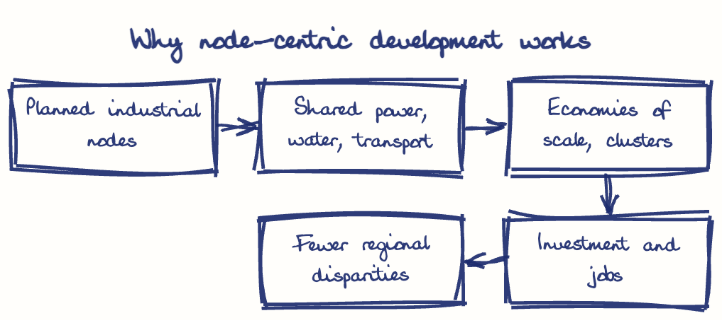
Industrial nodes act as growth poles, attracting investment and generating employment, reducing regional disparities.
Efficient Resource Utilization
Concentrated development creates economies of scale in infrastructure like power and transport.
Cluster-Based Industrialisation
Nodes foster shared suppliers and skilled labor pools, enhancing productivity.
Sustainable Urbanisation
Integrating urban infrastructure with industrial growth improves living standards and social inclusion.
This model answer is indicative and the model can make mistakes; please verify key facts independently.
Practise this question
1Get the answer sheet
Sized for this question.
2Write your answer
Timed, by hand.
3Get it marked
Your score and what to fix.
This chapter in the exam
Industrial Policy of the AP Government18 questions
Asked in 8 of 8 sittings since 2008
Most tested: MSME/SSI promotion and state industrial policy incentives
- 2025Critically Examine the industrial policy of the Andhra Pradesh government. What are the major initiatives, support measures and bottlenecks to industrial development in the state?
- 2023With respect to the Micro, Small and Medium Enterprises (MSMEs) in Andhra Pradesh, discuss the following : (i) Importance of MSMEs in Andhra Pradesh economy (ii) Scope and implementation of Dr. YSR Navodayam and ReSTART programmes in Andhra Pradesh.
All 18 questions, sorted by sub-topic, with model answers and practice.
Question from the official APPSC Group-I Mains 2017 paper. Answer written by Ghissu's engine and checked against our editorial standards. Found an error? Tell us and we correct it within 48 hours.