Discuss the sources and trends in revenue of the Andhra Pradesh Government before and after reorganization for the period 2011 – 12 to 2016 – 17.
In short
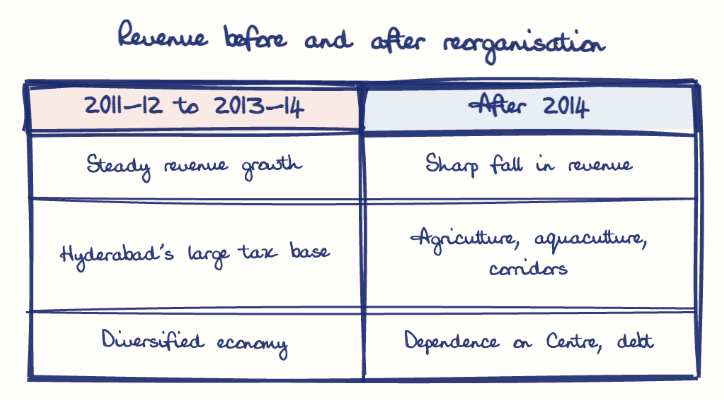
Andhra Pradesh's revenue came from own taxes (sales tax, excise, stamp duties, vehicle tax), its central tax share, non-tax revenue, grants and borrowings. It grew steadily until 2013-14, but bifurcation removed Hyderabad's tax base, causing a large revenue deficit from 2014-15 and heavier reliance on central transfers and borrowing.
Model answer
Ghissu Editorial · Verified 4 Oct 2026 · 250 words
Post-Reorganization Revenue Impact
Loss of Hyderabad’s tax base forced Andhra Pradesh to rely heavily on central grants and borrowings, including funds under the Andhra Pradesh Reorganisation Act, 2014. The state also focused on expanding its own tax base amid these challenges.
Fiscal Deficit and Capital Expenditure
The residual state ran a large revenue deficit from 2014-15, met partly by Fourteenth Finance Commission revenue deficit grants, while capital spending was squeezed. This constrained the state’s ability to invest in infrastructure and development.
Audit and Compliance Issues
CAG audits repeatedly found underassessment and leakages in tax and land departments, hampering revenue mobilization. These leakages highlighted the need for stronger revenue administration.
Debt and Fiscal Sustainability
Fiscal deficit widened and liabilities rose steadily after 2014, with off-budget borrowings straining finances. This raised concerns over long-term fiscal sustainability.
Policy Responses
The state sought special assistance under the Reorganisation Act and pressed for Special Category Status, which was never granted. It also introduced reforms in tax administration and digitization to improve compliance and revenue collection.
This model answer is indicative and the model can make mistakes; please verify key facts independently.
Practise this question
1Get the answer sheet
Sized for this question.
2Write your answer
Timed, by hand.
3Get it marked
Your score and what to fix.
This chapter in the exam
Resource mobilization in Andhra Pradesh20 questions
Asked in 8 of 8 sittings since 2008
Most tested: Andhra Pradesh’s revenue sources, central transfers, and resource allocation/resource gap after bifurcation.
- 2025Explain the major sources of budgetary resources for Andhra Pradesh. What are the key challenges the state faces in mobilising adequate financial resources?
- 2023Briefly discuss the impact of bifurcation on the economy of Andhra Pradesh with respect to sectoral changes and resource gap. Provide a brief note on the steps taken by the Government of Andhra Pradesh to mobilize resources.
All 20 questions, sorted by sub-topic, with model answers and practice.
Question from the official APPSC Group-I Mains 2017 paper. Answer written by Ghissu's engine and checked against our editorial standards. Found an error? Tell us and we correct it within 48 hours.