"Selfish attitude of human beings is the sole cause of environmental degradation." Discuss.
In short
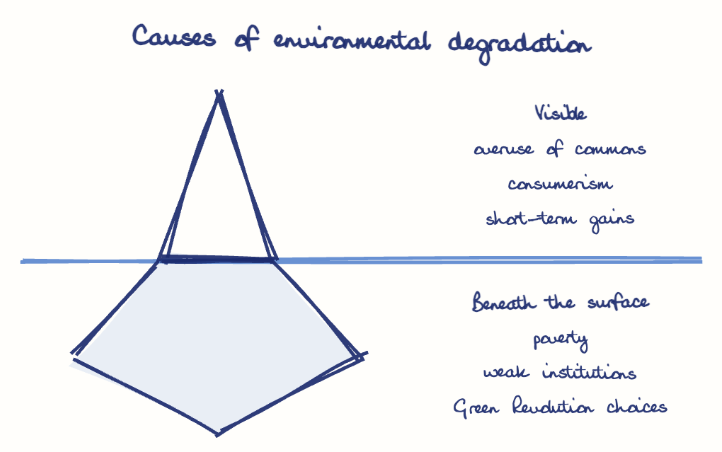
Selfishness is a key but not the sole cause of environmental degradation: the tragedy of the commons and consumerism drive overuse, as with groundwater over-extraction in Rayalaseema. Poverty, as in podu cultivation in the Eastern Ghats, weak institutions, Green Revolution technology, urbanisation and climate change also drive it.
Model answer
Ghissu Editorial · Verified 4 Oct 2026 · 259 words
Tragedy of the Commons1
Garrett Hardin’s theory explains resource depletion due to self-interest, seen in groundwater over-extraction in Rayalaseema drought belt of Andhra Pradesh, where individual use exceeds sustainable limits, causing long-term harm.
Feminist Critique2: Patriarchy’s Role
Feminist perspectives emphasize how patriarchal systems underpin environmental crises, linking gendered exploitation to ecological damage and highlighting the need for inclusive environmental governance.
Poverty-Induced Pressure
Tribal shifting (podu) cultivation in the Eastern Ghats of Andhra Pradesh reflects survival-driven environmental harm, not mere selfishness, as marginalized communities depend on shifting agriculture for livelihood.
Institutional Failures
Delays in compensatory afforestation in Andhra Pradesh show governance gaps worsening degradation; weak enforcement of environmental laws allows continued resource depletion beyond individual attitudes.
Economic Inequality
Wealth concentration causes overconsumption, while the poor overexploit resources, as in Krishna-Godavari delta aquaculture, creating dual environmental pressures.
This model answer is indicative and the model can make mistakes; please verify key facts independently.
Sources
Practise this question
1Get the answer sheet
Sized for this question.
2Write your answer
Timed, by hand.
3Get it marked
Your score and what to fix.
This chapter in the exam
Major Challenges of Indian Economy26 questions
Asked in 8 of 8 sittings since 2008
Most tested: Unemployment and employment structure
- 2025Discuss how infrastructure bottlenecks hinder the growth of the Indian Manufacturing sector. What steps can be taken to address them?
- 2025Analyse the factors contributing to India's Current Account Deficit (CAD) and unfavourable Balance of Payments (BoP) and discuss their implications for the Indian economy.
All 26 questions, sorted by sub-topic, with model answers and practice.
Question from the official APPSC Group-I Mains 2017 paper. Answer written by Ghissu's engine and checked against our editorial standards. Found an error? Tell us and we correct it within 48 hours.