Discuss the revenue and infrastructural challenges for new Andhra Pradesh after bifurcation in 2014.
In short
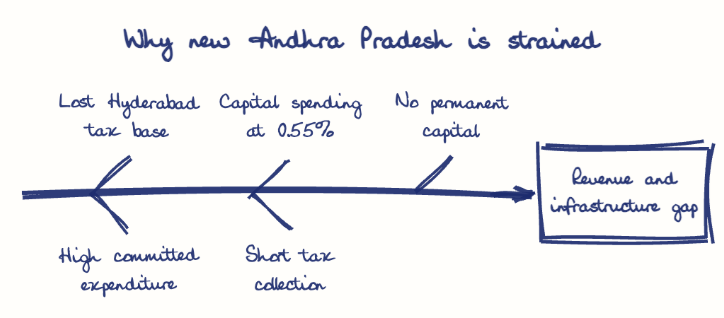
After the 2014 bifurcation, new Andhra Pradesh lost Hyderabad's revenue base and faced rising deficits, heavy committed spending and weak tax collection, along with no capital city, low capital expenditure and lagging irrigation and regional infrastructure. Capital expenditure fell to just 0.55% of GSDP in 2022-23, a five-year low.
Model answer
Ghissu Editorial · Verified 4 Oct 2026 · 254 words
Loss of Hyderabad Revenue Base
Telangana retained Hyderabad, the IT and pharma hub, causing Andhra Pradesh to lose significant tax revenue and industrial base.
Revenue Collection Inefficiencies
CAG audits revealed systemic issues, including ₹316.59 crore revenue shortfall in 2021-22 and ₹29.51 crore impact in 2022-23 from mining and tax underassessment.
Absence of Permanent Capital
Operating temporarily from Hyderabad delayed administrative infrastructure and governance efficiency.
Low Capital Expenditure
Capital spending fell to a five-year low at 0.55% of GSDP, hindering infrastructure growth.
Regional Disparities and Water Disputes
Rayalaseema and Uttara Andhra lag behind Coastal Andhra; Krishna and Godavari water sharing disputes delay irrigation projects like Polavaram.
Disrupted Economic Linkages
Loss of Hyderabad severed economic and administrative ties, forcing rebuilding from a weak base.
Demand for Special Category Status
Reflects fiscal needs due to bifurcation-induced revenue shortfalls and limited borrowing.
Political Transition Delays
New institutions and temporary capital slowed infrastructure rollout.
Legacy Regional Inequality
Bifurcation exacerbated uneven development across regions.
This model answer is indicative and the model can make mistakes; please verify key facts independently.
Practise this question
1Get the answer sheet
Sized for this question.
2Write your answer
Timed, by hand.
3Get it marked
Your score and what to fix.
This chapter in the exam
Andhra Pradesh - Bifurcation and its Impact8 questions
Asked in 4 of 8 sittings since 2008
Most tested: Apportionment and unresolved implementation issues under the Andhra Pradesh Reorganisation Act, 2014.
- 2025Examine the impact of the loss of Hyderabad as the capital city on post-bifurcation Andhra Pradesh. How did this transition affect the state's administrative, economic, and socio-cultural landscape?
- 2025Discuss the vision behind building a new capital for Andhra Pradesh after the bifurcation in 2014. Critically assess the financial implications involved in the planning, development, and partial execution of Amaravati as the capital city.
All 8 questions, sorted by sub-topic, with model answers and practice.
Question from the official APPSC Group-I Mains 2020 paper. Answer written by Ghissu's engine and checked against our editorial standards. Found an error? Tell us and we correct it within 48 hours.