Give a concise description of fisheries management and development in India?
In short
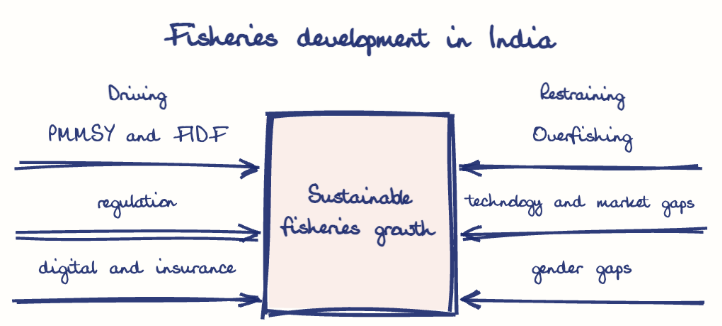
Fisheries management in India combines state regulation with central schemes, funds and institutions to raise production sustainably, though overfishing, outdated technology and weak markets persist. Backed by schemes like PMMSY, output more than doubled from 96 lakh tonnes in 2013-14 to 195 lakh tonnes in 2024-25.
Model answer
Ghissu Editorial · Verified 4 Oct 2026 · 261 words
Central-State Coordination and PMMSY
Fisheries is a state subject, but the central government’s Pradhan Mantri Matsya Sampada Yojana432 (PMMSY) aims to boost production by 70 lakh tonnes and double fishers’ incomes by 2024-25; Andhra Pradesh5 has actively enhanced infrastructure and welfare under PMMSY.
Dedicated Institutions and Digital Initiatives
The National Fisheries Development Board (NFDB) promotes R&D, while the Fisheries and Aquaculture Infrastructure Development Fund (FIDF) finances infrastructure; the Pradhan Mantri Matsya Kisan Samridhi Sah-Yojana (PM-MKSSY) formalizes the sector via digital platforms and insurance.
Overfishing and Resource Depletion
Several fish stocks are under pressure from overfishing, with illegal, unreported, and unregulated (IUU) fishing worsening depletion, as seen in arrests in Palk Bay.
Technological and Market Limitations
Many small-scale fishers lack GPS and fish finders; 69% of inland fishery output is sold in traditional markets with poor hygiene and low value addition.
Social Disparities and Export Growth
Women handle over 70% of post-harvest roles but remain undercompensated; seafood exports reached ₹62,408 crore in FY 2024-25, growing over 11%, with Andhra Pradesh as a key contributor.
Market and Social Empowerment
Improve hygienic processing facilities and empower women through skill development and fair wages.
This model answer is indicative and the model can make mistakes; please verify key facts independently.
Practise this question
1Get the answer sheet
Sized for this question.
2Write your answer
Timed, by hand.
3Get it marked
Your score and what to fix.
This chapter in the exam
Economic Geography6 questions
Asked in 3 of 8 sittings since 2008
Most tested: Andhra Pradesh’s economic infrastructure and sectoral development, especially ports, agriculture, and manufacturing.
- 2025Discuss the background of agriculture in Andhra Pradesh and critically examine how key agricultural inputs such as rainfall, temperature, irrigation and power are likely to be affected by climate change.
- 2025Highlight the industrial importance and major manufacturing sectors of Andhra Pradesh.
All 6 questions, sorted by sub-topic, with model answers and practice.
Question from the official APPSC Group-I Mains 2020 paper. Answer written by Ghissu's engine and checked against our editorial standards. Found an error? Tell us and we correct it within 48 hours.