Define ethics, with reference to ethics in Indian tradition. Mention five principles to manage ethics in public service.
In short
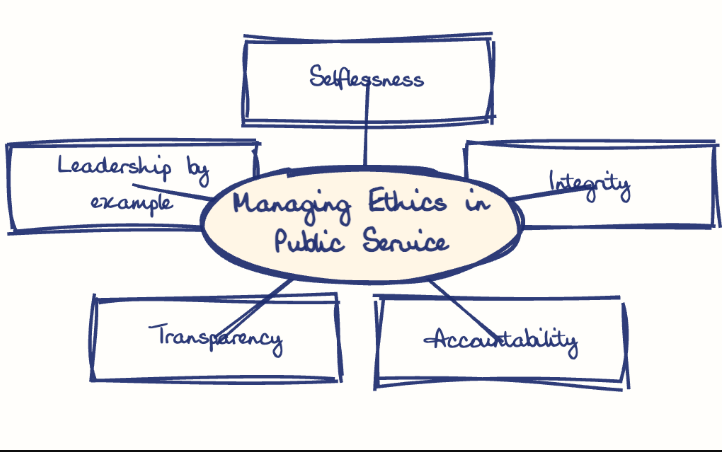
Ethics is the study of right and wrong conduct, and Indian tradition grounds it in Lokasangraha and Nishkama Karma (selfless action) from the Bhagavad Gita, and in Gandhi's insistence on pure means. Five principles to manage ethics in public service are selflessness, integrity, accountability, transparency and leadership by example.
Model answer
Ghissu Editorial · Verified 4 Oct 2026 · 268 words
Ethics as Moral Principles
Ethics governs right and wrong conduct, essential for accountability and transparency, as emphasized by the 2nd Administrative Reforms Commission’s report on Ethics in Governance (2007), which highlights ethics as key to good governance.
Philosophical Foundations
Indian ethics draws on Bhagavad Gita’s Lokasangraha and Nishkama Karma, focusing on selfless duty for collective welfare rather than personal gain.
Constitutional Embodiment
Article 51A of the Indian Constitution enshrines fundamental duties guiding civil servants to uphold justice, liberty, equality, and fraternity, reflecting constitutional morality as a foundation for ethical governance.
Selflessness
Nolan Committee’s principle mandates acting solely in public interest, avoiding personal gain to maintain impartiality.
Integrity
Andhra Pradesh’s Vigilance Awareness Week promotes honesty among officials through integrity pledges and awareness campaigns.
Accountability
Right to Information Act enables public scrutiny of civil servants, ensuring they are answerable for their actions and decisions.
Transparency
Andhra Pradesh’s e-governance initiatives enhance openness in governance by making information accessible and reducing corruption.
Leadership by Example
Leaders like Dr. A.P.J. Abdul Kalam inspire ethical conduct by demonstrating personal integrity and dedication to national development.
This model answer is indicative and the model can make mistakes; please verify key facts independently.
Practise this question
1Get the answer sheet
Sized for this question.
2Write your answer
Timed, by hand.
3Get it marked
Your score and what to fix.
This chapter in the exam
Ethics and Human Interface4 questions
Asked in 3 of 8 sittings since 2008
Most tested: Accountability in civil services and ethical handling of value conflicts
- 2025Public servants often face situations where personal values conflict with public responsibilities. Examine how a strong ethical foundation can help resolve such dilemmas while maintaining accountability.
- 2023Define 'Accountability'. Discuss the factors that have led to weakening of accountability in civil services. Suggest ways to improve the mechanisms for accountability in civil services.
All 4 questions, sorted by sub-topic, with model answers and practice.
Question from the official APPSC Group-I Mains 2020 paper. Answer written by Ghissu's engine and checked against our editorial standards. Found an error? Tell us and we correct it within 48 hours.