How does time and space effect ethics in private and public relationships? Illustrate.
In short
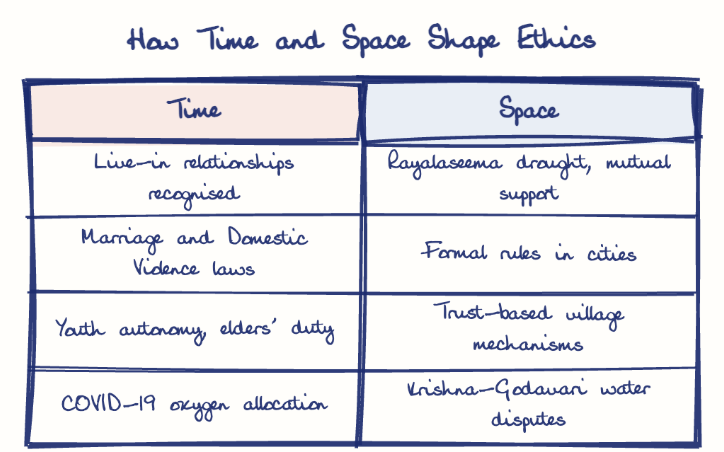
Time changes ethical norms: live-in relationships and laws like the Hindu Marriage Act (1955) reshaped private ethics, and crises like COVID-19 oxygen allocation showed how urgency shapes public ethics. Space matters: drought-hit Rayalaseema families stress mutual support, while urban life demands formal rules and rural life relies on trust.
Model answer
Ghissu Editorial · Verified 4 Oct 2026 · 260 words
Live-in Relationships1 as Evolving Kinship
The Supreme Court’s recognition reflects temporal shifts in private ethics challenging traditional marriage norms, acknowledging changing family structures and individual autonomy.
Legal Reforms Reflecting Social Change
Laws like the Domestic Violence Act and amendments to the Hindu Marriage Act illustrate how public ethics evolve over time to protect vulnerable groups and promote gender justice, influencing administrative conduct in Andhra Pradesh.
Women’s Negotiation of Gendered Spaces
Women’s solo travel2 in urban Andhra Pradesh highlights spatial ethical challenges around safety and autonomy, reflecting broader societal norms that restrict female mobility and public participation.
Panchayat-Imposed Boycotts
Boycotts on love marriages in rural areas create ethical conflicts between community enforcement and individual rights, illustrating how local spatial power dynamics impact personal freedoms.
Digital Governance Services
Government initiatives like DigiLocker, UMANG, DiKSHA, and API Setu enhance ethical public service delivery across spatial divides, promoting transparency and accessibility.
Ethical Trusteeship Concept
Gandhi’s trusteeship idea urges wealth holders to act for public welfare, integrating ethics across time and space by balancing individual rights with social responsibility.
This model answer is indicative and the model can make mistakes; please verify key facts independently.
Practise this question
1Get the answer sheet
Sized for this question.
2Write your answer
Timed, by hand.
3Get it marked
Your score and what to fix.
This chapter in the exam
Ethics and Human Interface4 questions
Asked in 3 of 8 sittings since 2008
Most tested: Accountability in civil services and ethical handling of value conflicts
- 2025Public servants often face situations where personal values conflict with public responsibilities. Examine how a strong ethical foundation can help resolve such dilemmas while maintaining accountability.
- 2023Define 'Accountability'. Discuss the factors that have led to weakening of accountability in civil services. Suggest ways to improve the mechanisms for accountability in civil services.
All 4 questions, sorted by sub-topic, with model answers and practice.
Question from the official APPSC Group-I Mains 2020 paper. Answer written by Ghissu's engine and checked against our editorial standards. Found an error? Tell us and we correct it within 48 hours.