What is a patent? Give examples of patents. What is the difference between process patents and product patents? How are GI tags related to patents?
In short
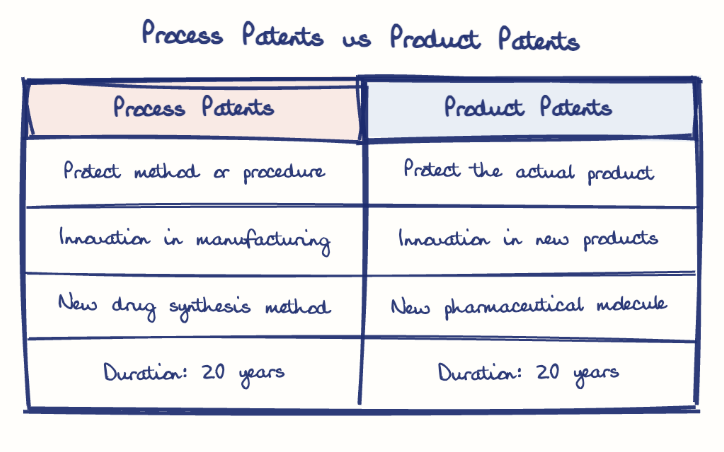
A patent is a government-granted exclusive right, usually for 20 years, over a novel, non-obvious and industrially useful invention; process patents protect the method, product patents the item itself. GI tags differ by protecting regional heritage such as Andhra Pradesh's Banganapalle mangoes and Tirupati laddu, not inventions.
Model answer
Ghissu Editorial · Verified 4 Oct 2026 · 307 words
Patent Definition and Criteria
Patents grant 20-year exclusive rights for inventions that are novel, non-obvious, and industrially applicable, as per the Indian Patents Act, 1970, which excludes certain areas like agriculture and biological processes to balance innovation with public interest.
Significant Cases and Impact
Diamond v. Chakrabarty (1980) expanded patent scope to genetically modified organisms, enabling biotech innovation; Novartis AG v. Union of India1 (2013) upheld public health by denying patents for minor drug modifications, illustrating India’s balanced patent policy.
Pharmaceutical and Biotechnology Patents
Post-TRIPS, India recognizes product patents, with Andhra Pradesh firms increasingly filing patents for new drug formulations; biotech patents cover inventions like genetically engineered microbes used in bioremediation.
Distinct but Complementary Protections
GI tags protect products tied to a region’s unique qualities, such as Andhra Pradesh’s Banganapalle mangoes and Kalamkari textiles, safeguarding traditional knowledge, while patents protect new inventions; both enhance economic value and prevent misuse.
Policy Significance
Protecting patents and GI tags supports innovation and preserves cultural heritage, promoting inclusive growth in states like Andhra Pradesh where agriculture and handicrafts are vital to the economy.
This model answer is indicative and the model can make mistakes; please verify key facts independently.
Sources
Practise this question
1Get the answer sheet
Sized for this question.
2Write your answer
Timed, by hand.
3Get it marked
Your score and what to fix.
This chapter in the exam
Intellectual Property Rights; Promotion of Science in AP and India6 questions
Asked in 4 of 8 sittings since 2008
Most tested: Patent-centric IPR understanding and commercialization of intellectual property in India.
- 2025Describe the importance of IPR in academic and industrial research collaborations.
- 2023What are the tools required for the successful commercialization of Intellectual Property Rights in India ? Discuss the role of CIPAM in commercialization of Intellectual Property Rights.
All 6 questions, sorted by sub-topic, with model answers and practice.
Question from the official APPSC Group-I Mains 2020 paper. Answer written by Ghissu's engine and checked against our editorial standards. Found an error? Tell us and we correct it within 48 hours.