Why is the number of patents granted in India still a fraction compared to China and US, even though India's global position in innovations has been rising over the years ?
In short
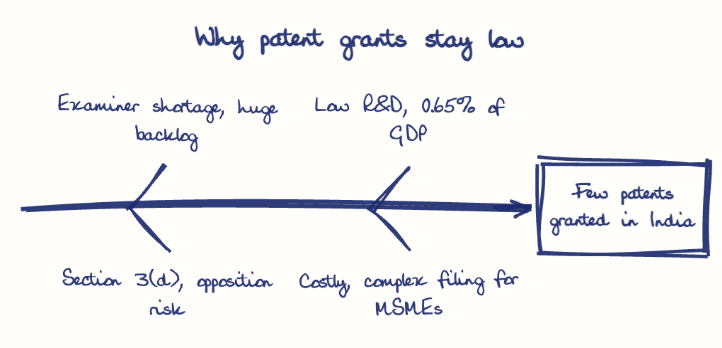
India grants far fewer patents than China and the US due to examiner shortages, backlogs, strict criteria like Section 3(d), costly filing and R&D spending of only 0.65% of GDP against China's 2.68%. Its rising innovation rank (39th in the 2024 Global Innovation Index) rests largely on less patent-intensive services.
Model answer
Ghissu Editorial · Verified 4 Oct 2026 · 261 words
Examiner Shortage and Backlogs
With only 132 examiners in 2016-17 handling nearly 2 lakh pending applications, patent grants face delays over five years; recent recruitment of 450 examiners and expedited filings for residents aim to ease this.
Restrictive Patent Law
India’s Section 3(d) and pre/post-grant opposition provisions, exemplified in Novartis AG v. Union of India2 (2013), protect public interest but reduce patent grants compared to China’s permissive regime.
Low R&D Spending
India’s GERD at 0.65% GDP is far below China’s 2.68%3, with government-led R&D dominating and limited private sector commercialization, constraining patentable innovation.
Complex Filing Process
High costs and procedural hurdles deter startups and MSMEs, especially outside metros, limiting patent conversion despite a 50% rise in filings.
Emerging Domestic Innovation
Increasing patent applications from Indian residents show growth, but systemic delays hinder grant rates.
Policy Differences
China’s MIC 2025 and massive R&D funding accelerate patent grants, contrasting with India’s cautious, public-interest-focused patent regime.
Innovation Incentives
Patent delays reduce R&D investment and commercialization, affecting startups reliant on patent protection.
Global Competitiveness
Low patent grants limit India’s technological sovereignty in sectors like semiconductors and 6G, impacting initiatives like the Bharat 6G Alliance.
This model answer is indicative and the model can make mistakes; please verify key facts independently.
Practise this question
1Get the answer sheet
Sized for this question.
2Write your answer
Timed, by hand.
3Get it marked
Your score and what to fix.
This chapter in the exam
Intellectual Property Rights; Promotion of Science in AP and India6 questions
Asked in 4 of 8 sittings since 2008
Most tested: Patent-centric IPR understanding and commercialization of intellectual property in India.
- 2025Describe the importance of IPR in academic and industrial research collaborations.
- 2023What are the tools required for the successful commercialization of Intellectual Property Rights in India ? Discuss the role of CIPAM in commercialization of Intellectual Property Rights.
All 6 questions, sorted by sub-topic, with model answers and practice.
Question from the official APPSC Group-I Mains 2023 paper. Answer written by Ghissu's engine and checked against our editorial standards. Found an error? Tell us and we correct it within 48 hours.