Discuss the establishment of the East India Company and its early operations in India.
In short
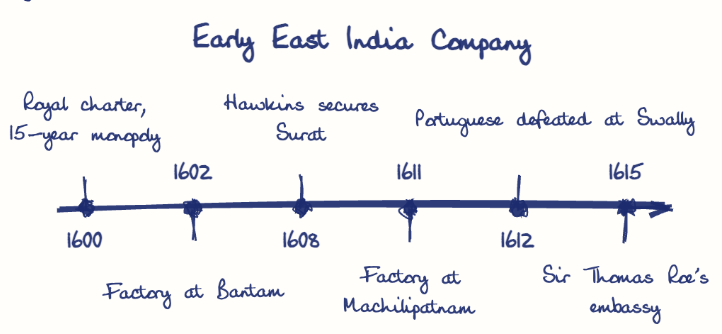
The East India Company was chartered by Queen Elizabeth I on 31 December 1600 as a trading monopoly, soon shifting from Indonesian spices to Indian textiles. After beating the Portuguese at Swally in 1612, it won a Surat factory in 1613 and opened another at Machilipatnam.
Model answer
Ghissu Editorial · Verified 4 Oct 2026 · 285 words
Royal Charter and Monopoly
Queen Elizabeth I granted the Company exclusive trade rights for 15 years between the Cape of Good Hope and Magellan Straits, aiming to challenge Iberian dominance in the spice trade. This monopoly enabled the Company to consolidate English efforts in Asian commerce.
Geopolitical Motivations
England’s rivalry with Spain and Portugal, plus advances in navigation, spurred the Company’s formation, leveraging the defeat of the Spanish Armada (1588) and explorers’ reports. The ambitions of merchants like Ralph Fitch inspired direct English access to Asian markets.
Entry into Indian Markets
Captain Hawkins reached Surat in 1608 and sought Jahangir’s permission to trade; after the naval victory at Swally (1612) against the Portuguese, Jahangir allowed a permanent factory at Surat in 1613, the Company’s first lasting foothold. This victory secured trading privileges and diminished Portuguese control.
Political Realignments
Aligning with Mughals and regional powers, the Company weakened Portuguese influence and set precedents for territorial expansion. Early diplomatic missions, such as Sir Thomas Roe’s embassy in 1615, secured firman for trade privileges, blending commerce with politics.
Preserve Colonial Heritage Sites
Protect early Company settlements like Surat and Machilipatnam to maintain tangible links to this formative period in Indo-British history.
This model answer is indicative and the model can make mistakes; please verify key facts independently.
Practise this question
1Get the answer sheet
Sized for this question.
2Write your answer
Timed, by hand.
3Get it marked
Your score and what to fix.
This chapter in the exam
The Mughals, the Marathas & the Advent of Europeans10 questions
Asked in 7 of 8 sittings since 2008
Most tested: Shivaji and the Maratha state formation, especially rise, administration and state character.
- 2025What impact did the activities of Christian missionaries have on Indian society and culture?
- 2023Discuss the features of Mughal architecture and examine the influence of Hindu elements on Mughal architecture.
All 10 questions, sorted by sub-topic, with model answers and practice.
Question from the official APPSC Group-I Mains 2025 paper. Answer written by Ghissu's engine and checked against our editorial standards. Found an error? Tell us and we correct it within 48 hours.