Discuss any two constitutional amendments that have significantly affected the powers or functioning of the Indian judiciary.
In short
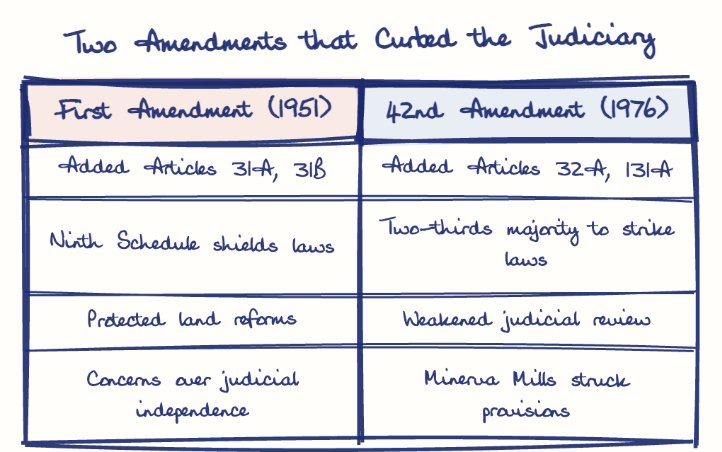
The First Amendment (1951) created Articles 31A, 31B and the Ninth Schedule to shield land reform laws from judicial review, while the 42nd Amendment (1976) curtailed judicial review through Article 32A and a two-thirds bench majority rule. Minerva Mills (1980) later struck down key 42nd Amendment provisions.
Model answer
Ghissu Editorial · Verified 4 Oct 2026 · 275 words
First Amendment (1951)
Enacted to protect land reform laws and speech restrictions from judicial invalidation by introducing Articles 31A, 31B, and the Ninth Schedule, it facilitated socio-economic reforms but limited judicial review, notably aiding Andhra Pradesh in implementing agrarian reforms. It also addressed concerns raised by early Supreme Court rulings that struck down progressive legislation on fundamental rights grounds.
Known as the “mini-Constitution,” it curtailed judicial review by restricting Supreme Court jurisdiction (Article 32A), prioritizing Directive Principles over Fundamental Rights, and requiring larger benches and majorities to strike down laws. Enacted during Emergency, it centralized power affecting states like Andhra Pradesh under Article 257A, which allowed the Centre to deploy forces in the state. The Supreme Court’s Minerva Mills Ltd. v. Union of India (1980) judgment struck down key provisions, reaffirming the Kesavananda Bharati (1973) basic structure doctrine and restoring judicial supremacy.
Promote Cooperative Federalism
Respect state autonomy, especially in sensitive regions like Andhra Pradesh, by balancing Centre-state relations through dialogue and constitutional mechanisms.
Enhance Transparency
Involve judicial experts in amendment scrutiny for democratic accountability, ensuring amendments do not undermine constitutional principles.
This model answer is indicative and the model can make mistakes; please verify key facts independently.
Practise this question
1Get the answer sheet
Sized for this question.
2Write your answer
Timed, by hand.
3Get it marked
Your score and what to fix.
This chapter in the exam
Judiciary in India15 questions
Asked in 8 of 8 sittings since 2008
Most tested: Judicial review and its scope/limits
- 2025What are the emergency functions of the Union Government of India? Describe how they impact the legislative powers of Parliament and State Legislatures.
- 2023Discuss the scope of Judicial review in reviewing administrative action, legislative enactments and judicial decisions.
All 15 questions, sorted by sub-topic, with model answers and practice.
Question from the official APPSC Group-I Mains 2025 paper. Answer written by Ghissu's engine and checked against our editorial standards. Found an error? Tell us and we correct it within 48 hours.