How does early value education in the family influence ethical decision-making in adulthood?
In short
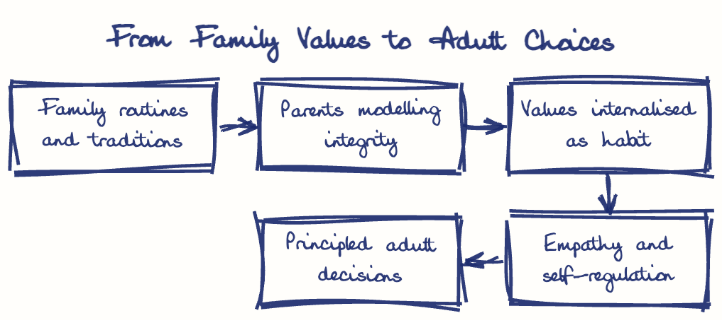
Early value education in the family, through role modelling and daily routines, builds internalised moral standards and emotional intelligence that guide principled decisions in adulthood. The family also remains a moral anchor later in life, though inherited hierarchical values can clash with modern egalitarian and professional ethics.
Model answer
Ghissu Editorial · Verified 4 Oct 2026 · 266 words
Role Modeling and Demonstrative Effect
Children imitate parental ethical conduct, making parents’ behavior critical in shaping lifelong values. Consistent parental integrity fosters trust and internalization of fairness and responsibility.
Informal Learning Environment
Families impart values through daily routines and cultural traditions, fostering a sense of duty and community belonging. In Andhra Pradesh, family participation in festivals reinforces respect for heritage and social harmony.
Development of Emotional Intelligence
Daniel Goleman’s framework shows family education enhances empathy and self-regulation, essential for ethical judgment. These emotional competencies improve interpersonal and professional ethics.
Support System and Accountability
Families remain moral anchors, providing guidance; in Andhra Pradesh, family and community networks uphold ethical norms amid modernization. This ongoing support reinforces accountability in ethical dilemmas.
Strengthen Parental Training Programs
Community workshops in Andhra Pradesh can help parents impart contemporary ethical values, bridging generational and societal gaps.
Integrate Family and School Efforts
Initiatives like the CBSE Parenting Calendar promote consistent value education across home and educational settings, ensuring reinforcement of ethical principles.
This model answer is indicative and the model can make mistakes; please verify key facts independently.
Practise this question
1Get the answer sheet
Sized for this question.
2Write your answer
Timed, by hand.
3Get it marked
Your score and what to fix.
This chapter in the exam
Human values6 questions
Asked in 3 of 8 sittings since 2008
Most tested: Sources and transmission of values through family, society and education
- 2025What ethical values are essential to ensure peaceful coexistence in a diverse society? Illustrate your answer with suitable examples.
- 2023Discuss the significance of values in the development of personality and socio-cultural systems. Add a brief note on the hierarchy of values in India.
All 6 questions, sorted by sub-topic, with model answers and practice.
Question from the official APPSC Group-I Mains 2025 paper. Answer written by Ghissu's engine and checked against our editorial standards. Found an error? Tell us and we correct it within 48 hours.