Discuss the role of the industrial sector in the economic development of India. Discuss the role of the Department of Industrial Policy & Promotion (DIPP).
In short
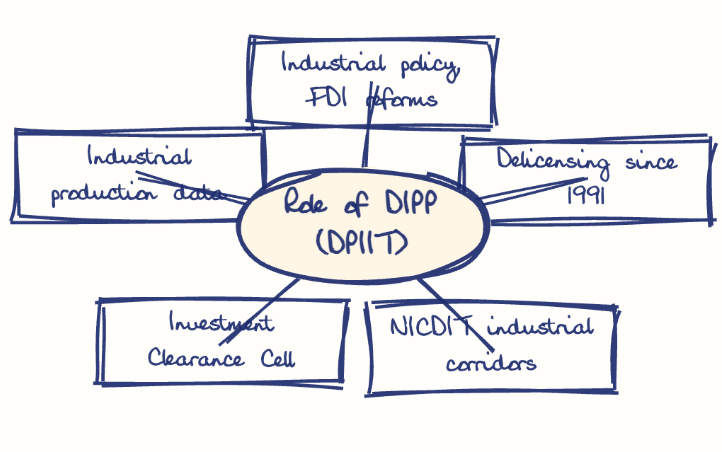
Industry drives India's growth, jobs and technology, while DIPP (now DPIIT) is the nodal agency for industrial policy, FDI reform, investment promotion and industrial corridors through NICDIT. Since the 1991 Industrial Policy it has abolished most licensing and widened automatic-route FDI, and now steers Make in India and PLI.
Model answer
Ghissu Editorial · Verified 4 Oct 2026 · 278 words
Manufacturing Growth and Employment
The PLI scheme boosted electronics production by 146% and created over 12 lakh jobs, yet manufacturing’s GDP share remains around 14-15%, with MSMEs struggling to scale.
Regional Disparities and Governance
Andhra Pradesh’s SPSEs contribute 6.69% to GSDP but face governance and arrears issues; mining revenue shortfalls and policy delays5 further constrain industrial dynamism.
MSME Support and Credit Access
Schemes like CGTMSE and Prime Minister’s Employment Generation Programme help formalise MSMEs and improve credit availability.
Data and Statistical Gaps
Despite merged Price and Production Statistics schemes, real-time industrial data gaps hinder effective policy calibration.
Enhance State-Centre Collaboration
Strengthen partnerships with states like Andhra Pradesh to resolve land and infrastructure bottlenecks via joint SPVs and streamlined governance.
Promote Greenfield FDI and Innovation
Expand PLI and support high-tech sectors under the National Capital Goods Policy to boost domestic manufacturing and R&D.
Improve Industrial Data Systems
Upgrade data infrastructure for timely, granular industrial performance monitoring.
This model answer is indicative and the model can make mistakes; please verify key facts independently.
Practise this question
1Get the answer sheet
Sized for this question.
2Write your answer
Timed, by hand.
3Get it marked
Your score and what to fix.
This chapter in the exam
Industrial Development and Policy (India)12 questions
Asked in 5 of 8 sittings since 2008
Most tested: Manufacturing-led industrial policy reform and its policy instruments.
- 2025Examine the role of the industrial sector in India's economic development. How does industrialisation contribute to income generation, employment, and modernisation of the economy? Support your answer with relevant examples and policy references.
- 2025Examine the role of the Startup India programme in promoting entrepreneurial development in India. What are the major features of the programme, and how has it contributed to the industrial and economic growth of the country?
All 12 questions, sorted by sub-topic, with model answers and practice.
Question from the official APPSC Group-I Mains 2025 paper. Answer written by Ghissu's engine and checked against our editorial standards. Found an error? Tell us and we correct it within 48 hours.