Critically examine the impact of climate change on dry land agriculture in Telangana and suggest climate-resilient technologies to protect rain-fed cropping systems.
In short
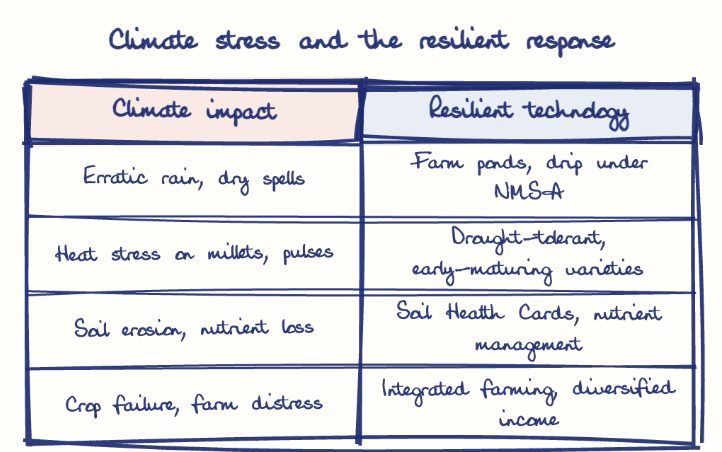
Climate change hurts Telangana's rain-fed dry land farming through erratic monsoons, droughts, rising temperatures and soil degradation, deepening distress among small farmers. Resilient options include farm ponds and micro-irrigation under NMSA, drought-tolerant millets and pulses, intercropping, Soil Health Cards and integrated farming, supported by Mission Kakatiya tank restoration.
Model answer
Ghissu Editorial · Verified 4 Oct 2026 · 282 words
Rising Temperatures and Soil Degradation
Heat stress increases evapotranspiration; soil erosion and nutrient loss degrade Telangana’s red and black soils, which are already low in organic matter, further reducing fertility and crop resilience.
Water Management under NMSA
In-situ moisture conservation, farm ponds, and drip irrigation optimize water use in drought-prone areas, enhancing crop survival during dry spells. These technologies are promoted under the National Mission for Sustainable Agriculture (NMSA).
Soil Health Cards1 and Nutrient Management
These improve organic matter and moisture retention, vital for dry land soils, by promoting integrated nutrient management and addressing nutrient deficiencies.
Integrated Farming Systems
Combining crops, horticulture, livestock, and agroforestry diversifies income; Telangana’s Mission Kakatiya restored minor irrigation tanks, indirectly strengthening these systems.
Research and Dissemination
Strengthen CRIDA Hyderabad’s role in developing Telangana-specific climate-resilient technologies and ensure their effective dissemination to farmers.
Digital Tools for Planning
Use GIS and remote sensing for drought early warning, precise land-use planning, and resource management to support climate-resilient agriculture.
This model answer is indicative and the model can make mistakes; please verify key facts independently.
Sources
Practise this question
1Get the answer sheet
Sized for this question.
2Write your answer
Timed, by hand.
3Get it marked
Your score and what to fix.
This chapter in the exam
Telangana: agriculture, irrigation, industry, transport, population, tribal areas2 questions
Asked in 1 of 2 sittings since 2016
Most tested: Telangana agriculture and irrigation policy, especially rain-fed/dryland farming and water-body based irrigation support.
Question from the official TGPSC Group-I Mains 2024 paper. Answer written by Ghissu's engine and checked against our editorial standards. Found an error? Tell us and we correct it within 48 hours.