How was the growth and development of modern industries in Hyderabad State under the VI and VII Nizams intimately linked to the select social elite?
In short
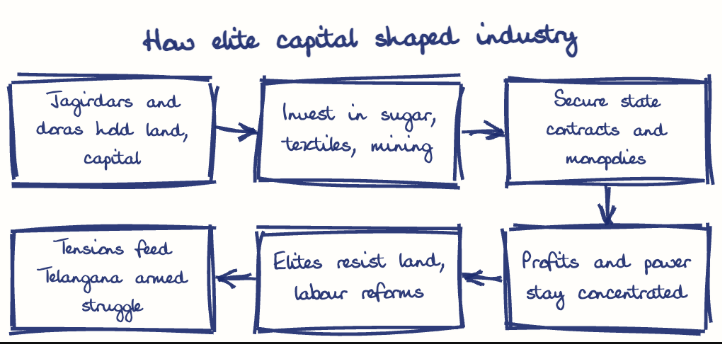
Under the VI and VII Nizams, industries like the Nizam Sugar Factory and Singareni coal mines grew through state patronage, railways and the capital of a narrow elite of jagirdars and doras. This dependence kept industry concentrated and unequal, and elite resistance to land reform fed the Telangana armed struggle.
Model answer
Ghissu Editorial · Verified 4 Oct 2026 · 258 words
Emergence of Modern Industries
The establishment of industries like the Nizam Sugar Factory and expansion of Singareni coal mines marked a shift from agrarian economy, supported by Nizam policies to boost revenues.
State Infrastructure Support
Investments in railways and electricity facilitated industrial growth by improving connectivity between mining and industrial centers.
Elite Control over Land and Capital
Jagirdars and landed aristocrats dominated land and capital, using their status to secure monopolies and state contracts, intertwining industrial growth with elite interests.
Symbiotic Political-Economic Relationship
The Nizam’s administration relied on elites for political stability and revenue, reinforcing their socio-political dominance and control over industrial ventures.
Consolidation of Power and Inequality
The elite-Nizam alliance concentrated industrial profits and power, limiting inclusive economic development and delaying reforms.
Resistance to Reforms and Social Tensions
Elite opposition to land and labor reforms fueled social unrest, exemplified by the Telangana2 Peasants’ Armed Struggle.
Inclusive Industrial Policies and Infrastructure
Promote marginalized participation and invest in infrastructure beyond urban centers, especially in Telangana.
Land and Labor Reforms
Implement reforms to dismantle feudal structures and protect workers, fostering equitable industrial growth.
This model answer is indicative and the model can make mistakes; please verify key facts independently.
Practise this question
1Get the answer sheet
Sized for this question.
2Write your answer
Timed, by hand.
3Get it marked
Your score and what to fix.
This chapter in the exam
Asaf Jahis: Salar Jung reforms, land tenures, 1857 in Hyderabad, modernisation2 questions
Asked in 1 of 2 sittings since 2016
Most tested: Salar Jung’s reformist statecraft and elite-linked modernisation of Hyderabad State.
Question from the official TGPSC Group-I Mains 2024 paper. Answer written by Ghissu's engine and checked against our editorial standards. Found an error? Tell us and we correct it within 48 hours.