'Despite Limitations and Challenges, Poverty Alleviation Programmes ensure socio-economic development in Urban Areas.' Examine.
In short
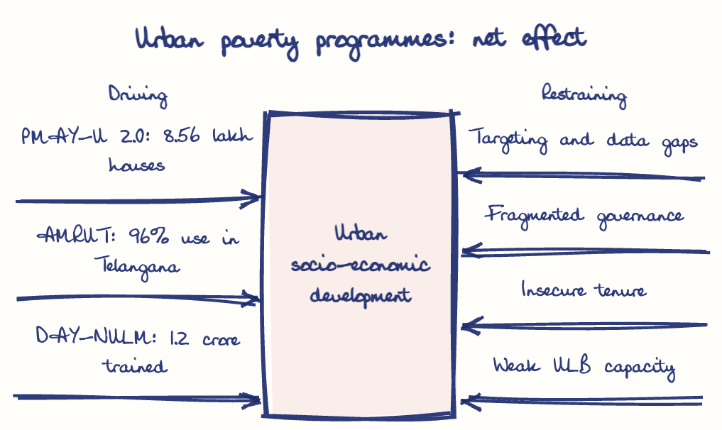
Despite poor targeting, fragmented governance and weak local capacity, urban poverty programmes have improved housing, infrastructure and livelihoods for the urban poor. PMAY-Urban 2.0 has sanctioned over 8.56 lakh houses, DAY-NULM has trained over 1.2 crore people, and Telangana's AMRUT reached 96% fund utilisation.
Model answer
Ghissu Editorial · Verified 4 Oct 2026 · 278 words
Housing and Infrastructure Deficits
Informal settlements lack tenure and amenities; PMAY-Urban 2.0 sanctioned 8.56 lakh houses, including 75,417 for women and marginalized groups. However, affordability and location issues persist, limiting access to livelihood opportunities.
Capacity and Resource Constraints
Telangana shows only 3% construction establishments registered3 under BOCW Act, reflecting enforcement and resource gaps. Additionally, many urban local bodies lack financial and institutional capacity to sustain programmes effectively.
Improved Urban Infrastructure
AMRUT has enhanced water and sewerage services; Telangana achieved 96% fund utilisation and 85% project completion, improving health4 and living standards. This has reduced urban vulnerabilities linked to poor sanitation.
Skill Development and Livelihood Support
DAY-NULM trained over 1.2 crore urban poor, linking many to jobs and reducing vulnerability. It promotes self-employment and economic empowerment, crucial for sustainable poverty reduction.
Expand Affordable Housing Linked to Livelihoods
Promote inclusive housing policies ensuring proximity to employment hubs and tenure security, learning from PMAY-U experiences.
Build ULB Capacity
Invest in training and resources, as seen in Telangana’s AMRUT success, to improve programme implementation and monitoring.
This model answer is indicative and the model can make mistakes; please verify key facts independently.
Practise this question
1Get the answer sheet
Sized for this question.
2Write your answer
Timed, by hand.
3Get it marked
Your score and what to fix.
This chapter in the exam
Development programmes, participatory development, rights to health, food and education1 question
Asked in 1 of 2 sittings since 2016
Most tested: Urban poverty alleviation programmes and their socio-economic impact.
Question from the official TGPSC Group-I Mains 2024 paper. Answer written by Ghissu's engine and checked against our editorial standards. Found an error? Tell us and we correct it within 48 hours.