Discuss briefly how Corporate Social Responsibility (CSR) contributes for achieving Substainable Development Goals.
In short
CSR, mandated by Section 135 of the Companies Act, 2013, advances the SDGs by channelling corporate funds into education, health, livelihoods and the environment, with SEBI's BRSR reporting adding accountability. Mahindra's Nanhi Kali has supported over 870,000 girls, though unspent funds and regional concentration limit impact.
Model answer
Ghissu Editorial · Verified 4 Oct 2026 · 276 words
Environmental and Social Contributions
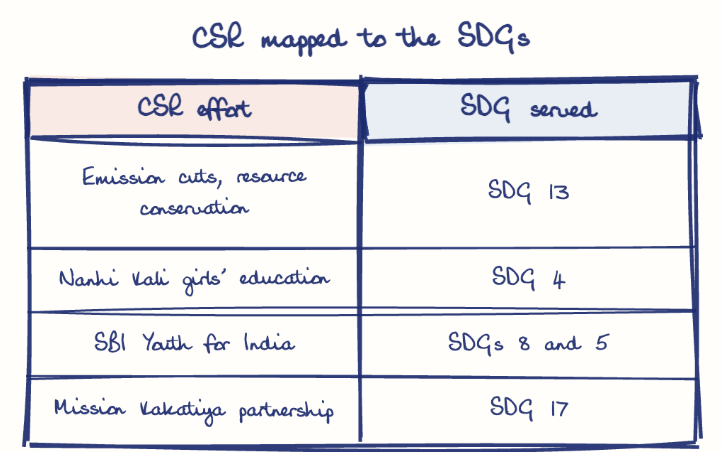
CSR drives environmental sustainability (SDG 13) through carbon emission reduction and waste management; social initiatives like Mahindra’s Nanhi Kali support education for over 870,000 girls, advancing SDG 3 and SDG 4. However, inconsistent CSR spending and unspent funds reveal implementation challenges.
Economic Empowerment and Inclusive Growth
CSR fosters economic inclusion via skill development and women’s empowerment, exemplified by SBI Youth for India impacting 150,000 lives, supporting SDG 5 and SDG 8. Yet, the mandatory 2% profit spending can burden smaller firms and overlap with government roles.
Integration and Transparency
The Business Responsibility and Sustainability Report (BRSR) framework mandated by SEBI enhances CSR transparency and aligns corporate projects with India’s SDG agenda.
Multi-Stakeholder Partnerships
Collaborations like Telangana’s Mission Kakatiya for water conservation exemplify SDG 17 partnerships, though clear role definitions are needed to avoid governance issues.
Regional Equity and Impact Measurement
Direct CSR funds to underdeveloped areas and mandate robust impact assessments linked to SDG indicators.
Beyond Compliance
Promote voluntary CSR innovation and embed sustainability into core business strategies.
This model answer is indicative and the model can make mistakes; please verify key facts independently.
Practise this question
1Get the answer sheet
Sized for this question.
2Write your answer
Timed, by hand.
3Get it marked
Your score and what to fix.
This chapter in the exam
Development debates, civil society, SHGs, PPP, CSR2 questions
Asked in 1 of 2 sittings since 2016
Most tested: Civil society / CSR as instruments of good governance and development outcomes
Question from the official TGPSC Group-I Mains 2024 paper. Answer written by Ghissu's engine and checked against our editorial standards. Found an error? Tell us and we correct it within 48 hours.