Discuss the impact of globalization on Indian culture and society.
In short
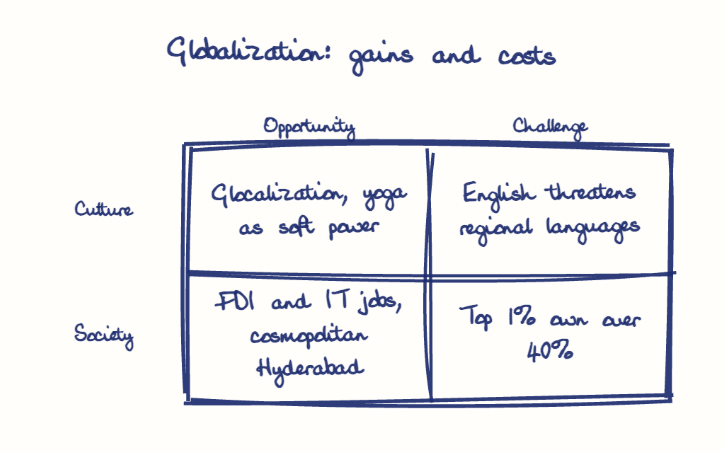
Globalization has made Indian culture more hybrid and global, spreading yoga and Ayurveda abroad while raising fears for regional languages and traditions. Socially it has expanded jobs, urbanisation and individualism in hubs like Hyderabad but widened inequality, with India's top 1% owning over 40% of wealth.
Model answer
Ghissu Editorial · Verified 4 Oct 2026 · 248 words
Cultural Homogenization and Language Threats
Anthony Giddens1’ ‘Runaway World’ thesis warns that English’s dominance in urban India risks eroding regional languages and cultural diversity. This linguistic shift threatens the survival of indigenous dialects, undermining India’s pluralistic heritage.
Economic Growth and Urbanization
India’s trade-to-GDP ratio and FDI inflows have surged, with Hyderabad exemplifying urban cosmopolitanism and IT sector growth, yet Oxfam reports the top 1% owns over 40% of wealth, highlighting inequality. This economic boom coexists with precarious informal employment lacking social security.
Digital Media2’s Amplification of Social Violence
Over 900 million internet users experience both social inclusion and communal tensions, as digital platforms amplify misinformation and violence. The dual role of digital connectivity shapes social mobilization and conflict dynamics.
Inclusive Cultural and Social Policies
Promoting regional languages and social security for informal workers in urban centers like Hyderabad is vital. Strengthening traditional arts and cultural preservation schemes can sustain diversity.
This model answer is indicative and the model can make mistakes; please verify key facts independently.
Practise this question
1Get the answer sheet
Sized for this question.
2Write your answer
Timed, by hand.
3Get it marked
Your score and what to fix.
This chapter in the exam
Indian society: features, family, caste, tribe, religion, rural-urban2 questions
Asked in 1 of 2 sittings since 2016
Most tested: Caste in modern/urban India
Question from the official TGPSC Group-I Mains 2024 paper. Answer written by Ghissu's engine and checked against our editorial standards. Found an error? Tell us and we correct it within 48 hours.