'The promise of decentralisation of public service delivery is based on the hope that the local bodies will promote required standards of accountability.' Examine.
In short
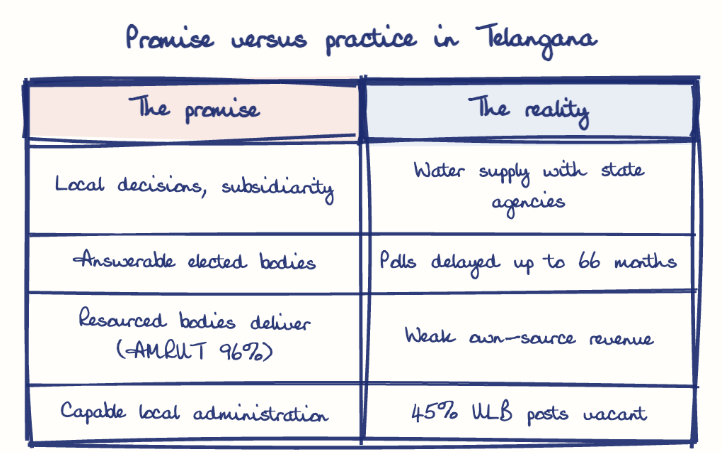
Decentralisation promises accountable services by bringing decisions closer to citizens through the 73rd and 74th Amendments, Gram Sabhas and social audits, but that promise holds only with real funds, staff and elections. In Telangana, urban local bodies face 45% staff vacancies and elections delayed by up to 66 months.
Model answer
Ghissu Editorial · Verified 4 Oct 2026 · 268 words
Subsidiarity and Local Governance
NITI Aayog’s 2024 Framework advocates Empowered Mayors1 and Unified Urban Governance to enhance decision-making at local levels, ensuring services are tailored to local needs.
Citizen Participation and Transparency
Schemes like Swachh Bharat Mission and Rashtriya Gram Swaraj Abhiyan2 promote direct citizen involvement in planning and monitoring, increasing accountability and reducing corruption.
Partial Devolution and Capacity Issues
Telangana’s 45% vacancy in sanctioned posts and delayed ULB elections (up to 66 months) limit accountability and service delivery, weakening administrative continuity.
Audit Findings and Governance Gaps
CAG audits highlight systemic probity failures and incomplete financial oversight, limiting local bodies’ autonomy and transparency in resource utilisation.
Full Devolution and Capacity Building
States must transfer full functions and adequate resources to local bodies, supported by targeted training programs like Mission Karmayogi to enhance administrative and financial management skills.
Strengthening Electoral and Audit Mechanisms
Timely conduct of local body elections and empowering social audits with citizen participation are essential to uphold democratic accountability and deter corruption.
This model answer is indicative and the model can make mistakes; please verify key facts independently.
Practise this question
1Get the answer sheet
Sized for this question.
2Write your answer
Timed, by hand.
3Get it marked
Your score and what to fix.
This chapter in the exam
State and district administration, local governance, devolution3 questions
Asked in 1 of 2 sittings since 2016
Most tested: Decentralisation and accountability in local governance
Question from the official TGPSC Group-I Mains 2024 paper. Answer written by Ghissu's engine and checked against our editorial standards. Found an error? Tell us and we correct it within 48 hours.