2013 · GS Paper 2 · Q20 · 10 marks
Economic ties between India and Japan while growing in the recent years are still far below their potential. Elucidate the policy constraints which are inhibiting this growth.
In short
India-Japan economic ties lag their potential because of Indian policy frictions, such as retrospective tax, land and labour hurdles and weak infrastructure, and Japanese ones, such as non-tariff barriers and nuclear and arms export curbs. Bilateral trade stayed below US$ 20 billion in 2012-13 despite the 2011 CEPA.
Model answer
Ghissu Editorial · Verified 4 Oct 2026 · 284 words
Regulatory Unpredictability
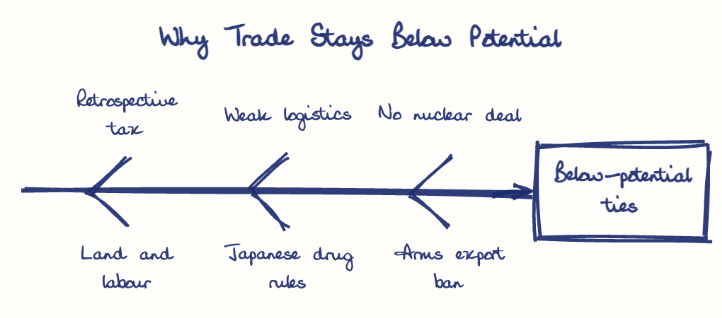
The 2012 retrospective tax amendment after the Vodafone ruling signalled that settled positions could be reopened, which alarmed risk-averse Japanese investors.
Land and Labour
Land acquisition delays slowed the Japan-backed Delhi-Mumbai Industrial Corridor, and the 2012 Manesar plant violence at Maruti Suzuki raised labour concerns.
Infrastructure Gaps
Power shortages, poor freight logistics and port delays raise costs for the just-in-time supply chains Japanese manufacturers run.
Sectoral FDI Caps
26% ceilings on foreign stakes in insurance and defence in 2013 denied Japanese firms the control they sought.
Non-tariff Barriers
Japan's strict drug approval and food safety standards blunted CEPA's tariff cuts for Indian generics and farm goods, keeping Indian exports narrow and petroleum-heavy.
Nuclear and Defence Curbs
Without a civil nuclear deal in 2013 and with India outside the NPT, Japanese reactor suppliers stayed out, while arms export curbs stalled the US-2 aircraft talks.
This model answer is indicative and the model can make mistakes; please verify key facts independently.
Practise this question
1Get the answer sheet
Sized for this question.
2Write your answer
Timed, by hand.
3Get it marked
Your score and what to fix.
This chapter in the exam
Bilateral7 questions
Asked in 6 of 14 sittings since 2013
- 2025India-Africa digital partnership is achieving mutual respect, co-development and long-term institutional partnerships. Elaborate.
- 2021"If the last few decades were of Asia's growth story, the next few are expected to be of Africa's." In the light of this statement, examine India's influence in Africa in recent years.
All 7 questions, sorted by sub-topic, with model answers and practice.
Question from the official UPSC Civil Services (Main) Examination 2013 paper. Answer written by Ghissu's engine and checked against our editorial standards. Found an error? Tell us and we correct it within 48 hours.