2013 · GS Paper 2 · Q3 · 10 marks
Recent directives from Ministry of Petroleum and natural Gas are perceived by the Nagas as a threat to override the exceptional status enjoyed by the State. Discuss in light of Article 371A of the Indian Constitution.
In short
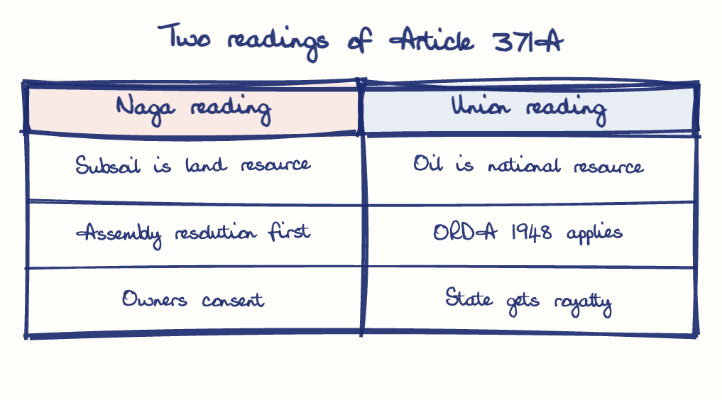
Nagas saw MoPNG's 2013 directives as overriding Article 371A, which bars Parliament's laws on land and its resources in Nagaland without the Assembly's consent. The Union relies on Entry 53 of the Union List and the Oilfields Act, 1948, so the clash needs a negotiated settlement.
Model answer
Ghissu Editorial · Verified 4 Oct 2026 · 314 words
Textual guarantee
The provision begins with a non obstante clause, and in 2010 the Nagaland Assembly resolved that central petroleum laws would not apply in the state.
Community land
Land in Nagaland is owned largely by villages, clans and individuals, so Nagas read "resources" to include subsoil oil and framed the Nagaland Petroleum and Natural Gas Regulations, 2012.
Distrust
ONGC stopped drilling in 1994 amid local opposition, and a unilateral order during the peace talks revived fears that special status was hollow.
Union List primacy
Entry 53 of the Union List and the Oilfields (Regulation and Development) Act, 1948 give the Centre power over mineral oil, which it treats as a national resource rather than a land right.
Revenue stays local
Royalty on onshore crude goes to the producing state, so central licensing does not deprive Nagaland of the benefit.
Unsettled meaning
The Supreme Court has not ruled whether subsoil minerals are "land and its resources".
This model answer is indicative and the model can make mistakes; please verify key facts independently.
Practise this question
1Get the answer sheet
Sized for this question.
2Write your answer
Timed, by hand.
3Get it marked
Your score and what to fix.
This chapter in the exam
Significant Provisions — Special Provisions, Co-operative Societies & Official Language3 questions
Asked in 3 of 14 sittings since 2013
- 2025Discuss the nature of Jammu and Kashmir Legislative Assembly after the Jammu and Kashmir Reorganization Act, 2019. Briefly describe the powers and functions of the Assembly of the Union Territory of Jammu and Kashmir.
- 2016To what extent is Article 370 of the Indian Constitution, bearing marginal note temporary provision with respect to the State of Jammu and Kashmir, temporary? Discuss the future prospects of this provision in the context of Indian polity.
Question from the official UPSC Civil Services (Main) Examination 2013 paper. Answer written by Ghissu's engine and checked against our editorial standards. Found an error? Tell us and we correct it within 48 hours.