2025 · GS Paper 2 · Q4 · 10 marks
Discuss the nature of Jammu and Kashmir Legislative Assembly after the Jammu and Kashmir Reorganization Act, 2019. Briefly describe the powers and functions of the Assembly of the Union Territory of Jammu and Kashmir.
In short
After the 2019 Reorganisation Act, the Jammu and Kashmir Assembly is a subordinate Union Territory legislature on the Puducherry model under Article 239A. It legislates on State and Concurrent List subjects except police and public order, with the Lieutenant Governor controlling assent, Money Bills and key services.
Model answer
Ghissu Editorial · Verified 4 Oct 2026 · 295 words
The Jammu and Kashmir Reorganisation Act, 2019 replaced the State with the Union Territory of Jammu and Kashmir with a legislature, first elected in 2024 after the Supreme Court's 2023 direction in In re Article 370.
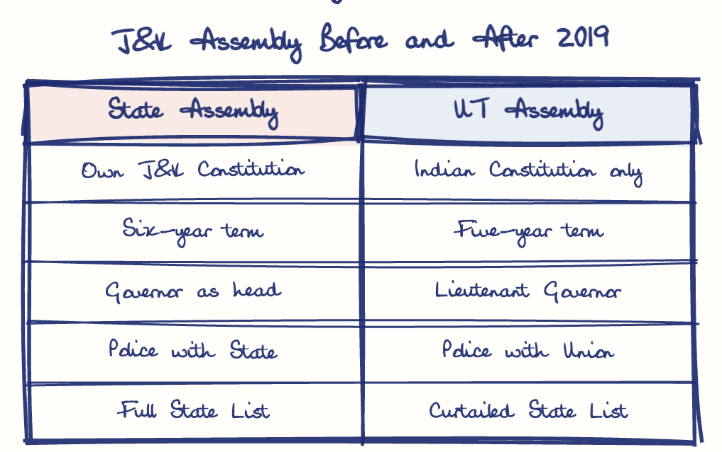
Nature of the Assembly after the 2019 Act
J&K Assembly Before and After 2019 a: State Assembly b: UT Assembly → Own J&K Constitution :: Indian Constitution only → Six-year term :: Five-year term → Governor as head :: Lieutenant Governor → Police with State :: Police with Union → Full State List :: Curtailed State List
1. Statutory UT legislature: Section 13 extends Article 239A, the Puducherry model, so Parliament can reshape the Assembly by ordinary law. 2. Composition: After the 2022 delimitation, 90 of 114 seats are filled by election (24 kept vacant for Pakistan-occupied territory), with 9 ST and 7 SC seats. 3. Nominated members: The Lieutenant Governor may nominate two women, and since 2023 two Kashmiri migrants and one displaced person.
Legislative
Under Section 32 it legislates on State List subjects except police and public order, and on Concurrent List subjects, with parliamentary law prevailing.
Financial
It passes the budget and grants, but Money Bills need the Lieutenant Governor's recommendation.
Oversight
It holds Omar Abdullah's Council of Ministers (2024) accountable, though the July 2024 Business Rules amendment kept police, All India Services and the Anti-Corruption Bureau with the Lieutenant Governor.
Assent
The Lieutenant Governor may assent to, withhold or reserve Bills for the President, and may issue ordinances.
This model answer is indicative and the model can make mistakes; please verify key facts independently.
Practise this question
1Get the answer sheet
Sized for this question.
2Write your answer
Timed, by hand.
3Get it marked
Your score and what to fix.
This chapter in the exam
Significant Provisions — Special Provisions, Co-operative Societies & Official Language3 questions
Asked in 3 of 14 sittings since 2013
- 2016To what extent is Article 370 of the Indian Constitution, bearing marginal note temporary provision with respect to the State of Jammu and Kashmir, temporary? Discuss the future prospects of this provision in the context of Indian polity.
- 2013Recent directives from Ministry of Petroleum and natural Gas are perceived by the Nagas as a threat to override the exceptional status enjoyed by the State. Discuss in light of Article 371A of the Indian Constitution.
Question from the official UPSC Civil Services (Main) Examination 2025 paper. Answer written by Ghissu's engine and checked against our editorial standards. Found an error? Tell us and we correct it within 48 hours.