2013 · GS Paper 2 · Q14 · 10 marks
The basis of providing urban amenities in rural areas (PURA) is rooted in establishing connectivity. Comment.
In short
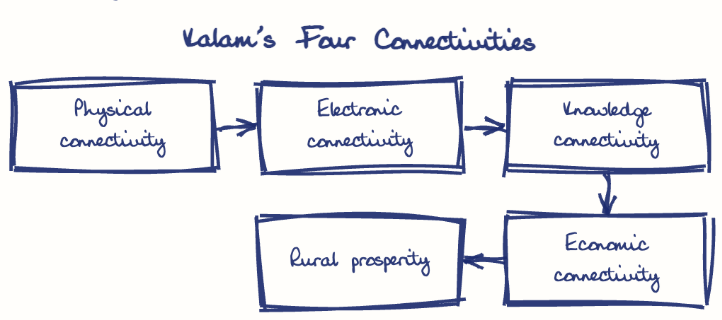
PURA rests on Kalam's four connectivities, physical, electronic and knowledge links leading to economic connectivity, but it also needs livelihoods, convergence and empowered panchayats to succeed. The Shyama Prasad Mukherji Rurban Mission (2016) carried the idea forward with gap funding for 300 Rurban clusters.
Model answer
Ghissu Editorial · Verified 4 Oct 2026 · 275 words
Cluster logic
Linking a cluster of villages to a growth centre creates enough combined demand to make hospitals, colleges and markets viable where one village cannot.
Proof of concept
The Periyar PURA around Vallam in Thanjavur, Tamil Nadu, joined roads, a college-led knowledge hub and village enterprises, and Kalam cited it as his model.
Present carriers
PMGSY roads, BharatNet fibre to gram panchayats and Common Services Centres now supply the links PURA assumed.
Paying capacity
The PURA pilots, later restructured in PPP mode, stalled because private partners could not recover costs from thin user charges.
Weak local government
Clusters cut across panchayat boundaries, and panchayats meant to handle Eleventh Schedule subjects under Article 243G lacked funds and staff.
No convergence
PURA had no pooled fund, a gap the Shyama Prasad Mukherji Rurban Mission (2016) filled with Critical Gap Funding for 300 clusters.
This model answer is indicative and the model can make mistakes; please verify key facts independently.
Practise this question
1Get the answer sheet
Sized for this question.
2Write your answer
Timed, by hand.
3Get it marked
Your score and what to fix.
This chapter in the exam
Welfare Schemes9 questions
Asked in 6 of 14 sittings since 2013
- 2023"Development and welfare schemes for the vulnerable, by its nature, are discriminatory in approach." Do you agree ? Give reasons for your answer.
- 2022Reforming the government delivery system through the Direct Benefit Transfer Scheme is a progressive step, but it has its limitations too. Comment.
All 9 questions, sorted by sub-topic, with model answers and practice.
Question from the official UPSC Civil Services (Main) Examination 2013 paper. Answer written by Ghissu's engine and checked against our editorial standards. Found an error? Tell us and we correct it within 48 hours.