2013 · GS Paper 2 · Q12 · 10 marks
The Central Government frequently complains on the poor performance of the State Governments in eradicating suffering of the vulnerable sections of the society. Restructuring of Centrally sponsored schemes across the sectors for ameliorating the cause of vulnerable sections of population aims at providing flexibility to the States in better implementation. Critically evaluate.
In short
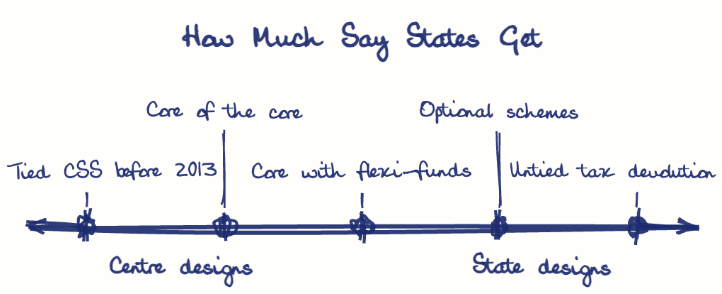
Restructuring of Centrally Sponsored Schemes since 2013 has given states real but bounded flexibility, protecting core welfare spending while leaving design, timing and a growing cost share with the Centre. The 2015 NITI Aayog Sub-Group ring-fenced MGNREGA and the SC, ST and minority umbrella schemes as core-of-the-core.
Model answer
Ghissu Editorial · Verified 4 Oct 2026 · 296 words
Umbrella and flexi-funds
Umbrella schemes and flexi-funds (10% from 2013, 25% after 2016) let states adapt schemes to local vulnerable groups.
Ring-fenced protection
MGNREGA, the National Social Assistance Programme and the umbrella schemes for SCs, STs, minorities and backward classes became core-of-the-core.
Untied money
The 14th Finance Commission raised states' share of divisible taxes from 32% to 42% from 2015, letting states run their own welfare schemes.
Matching burden
The 60:40 sharing strains poorer states, and the December 2025 law that replaced MGNREGA asks most states to bear 40% of its cost.
Central control and squeeze
Guidelines and Single Nodal Agency rules (2021) stay central, and combined CSS outlays were cut from ₹5.41 lakh crore budgeted to ₹4.20 lakh crore in the 2025-26 revised estimates.
State capacity
The CAG found Bihar's construction workers' welfare board spent only 5-34% of its funds on welfare during 2017-22, giving the Centre's complaint substance.
This model answer is indicative and the model can make mistakes; please verify key facts independently.
Practise this question
1Get the answer sheet
Sized for this question.
2Write your answer
Timed, by hand.
3Get it marked
Your score and what to fix.
This chapter in the exam
Welfare Schemes9 questions
Asked in 6 of 14 sittings since 2013
- 2023"Development and welfare schemes for the vulnerable, by its nature, are discriminatory in approach." Do you agree ? Give reasons for your answer.
- 2022Reforming the government delivery system through the Direct Benefit Transfer Scheme is a progressive step, but it has its limitations too. Comment.
All 9 questions, sorted by sub-topic, with model answers and practice.
Question from the official UPSC Civil Services (Main) Examination 2013 paper. Answer written by Ghissu's engine and checked against our editorial standards. Found an error? Tell us and we correct it within 48 hours.