2013 · GS Paper 2 · Q9 · 10 marks
The concept of Mid Day Meal (MDM) scheme is almost a century old in India with early beginnings in Madras Presidency in pre-independent India. The scheme has again been given impetus in most states in the last two decades. Critically examine its twin objectives, latest mandates and success.
In short
The Mid Day Meal scheme, now PM POSHAN, has largely met its educational objective of drawing children into school but only partly its nutritional objective. NFHS-5 (2019-21) still records 35.5% of under-five children stunted despite the meal becoming a legal entitlement under NFSA 2013.
Model answer
Ghissu Editorial · Verified 4 Oct 2026 · 295 words
From the Madras Corporation's meals for poor schoolchildren in 1925 to K. Kamaraj's statewide expansion in the 1950s, the scheme now runs as PM POSHAN. Its revival rests on the Supreme Court's 2001 orders in PUCL v Union of India and the National Food Security Act, 2013.
Twin Objectives and Latest Mandates
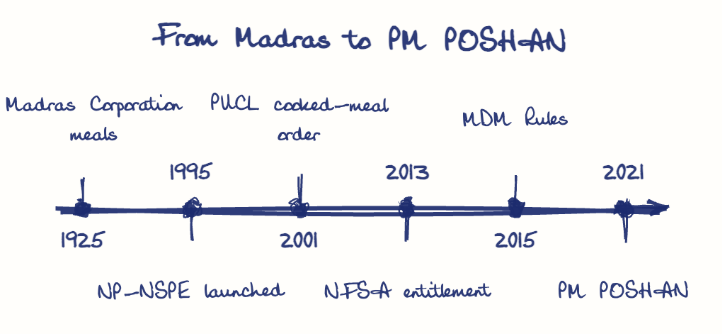
From Madras to PM POSHAN → 1925 :: Madras Corporation meals → 1995 :: NP-NSPE launched → 2001 :: PUCL cooked-meal order → 2013 :: NFSA entitlement → 2015 :: MDM Rules → 2021 :: PM POSHAN
1. Nutrition and education: The meal fights classroom hunger (450 kcal and 12 g protein at primary level, 700 kcal and 20 g at upper primary) and draws girls and Dalit and Adivasi children into school. 2. Legal mandate: NFSA 2013 made a free daily meal an entitlement for children aged 6-14, and the MDM Rules 2015 added a food security allowance when meals are missed. 3. New mandates: PM POSHAN (2021) covers Balvatika pre-primary children, promotes nutrition gardens and Tithi Bhojan, and keeps post-Chhapra food-safety rules.
Gains
Drèze and Goyal (2003) found sharp gains in girls' attendance, and an IFPRI study in Nature Communications (2021) linked mothers' childhood access to the meal with taller children.
Persisting malnutrition
NFHS-5 (2019-21) still records 35.5% of under-five children stunted and 67.1% anaemic.
Delivery failures
The 2013 Chhapra poisoning killed 23 children in Bihar, and caste prejudice persists, as in Champawat, Uttarakhand, in 2021, when students refused a Dalit cook's meal.
This model answer is indicative and the model can make mistakes; please verify key facts independently.
Practise this question
1Get the answer sheet
Sized for this question.
2Write your answer
Timed, by hand.
3Get it marked
Your score and what to fix.
This chapter in the exam
Welfare Schemes9 questions
Asked in 6 of 14 sittings since 2013
- 2023"Development and welfare schemes for the vulnerable, by its nature, are discriminatory in approach." Do you agree ? Give reasons for your answer.
- 2022Reforming the government delivery system through the Direct Benefit Transfer Scheme is a progressive step, but it has its limitations too. Comment.
All 9 questions, sorted by sub-topic, with model answers and practice.
Question from the official UPSC Civil Services (Main) Examination 2013 paper. Answer written by Ghissu's engine and checked against our editorial standards. Found an error? Tell us and we correct it within 48 hours.